


Hello everyone 👋 I’m Kate Syuma, and welcome to Growthmates.news — the newsletter where we explore growth stories to inspire your professional and personal growth. Join the community of 7,400+ Product, Design, and Growth people from companies like Amplitude, Intercom, Miro, Atlassian, Grammarly, Framer, and more.
Most products don’t lose users because they’re hard to use. They lose them because nothing meaningful happens early enough.
In the first session, users aren’t looking for mastery or feature depth. They’re looking for a reason to believe — that this product makes sense, feels relevant, and won’t make them feel lost or incapable. This issue is about what really matters in the first 60 seconds — and how products can earn confidence before asking for effort.
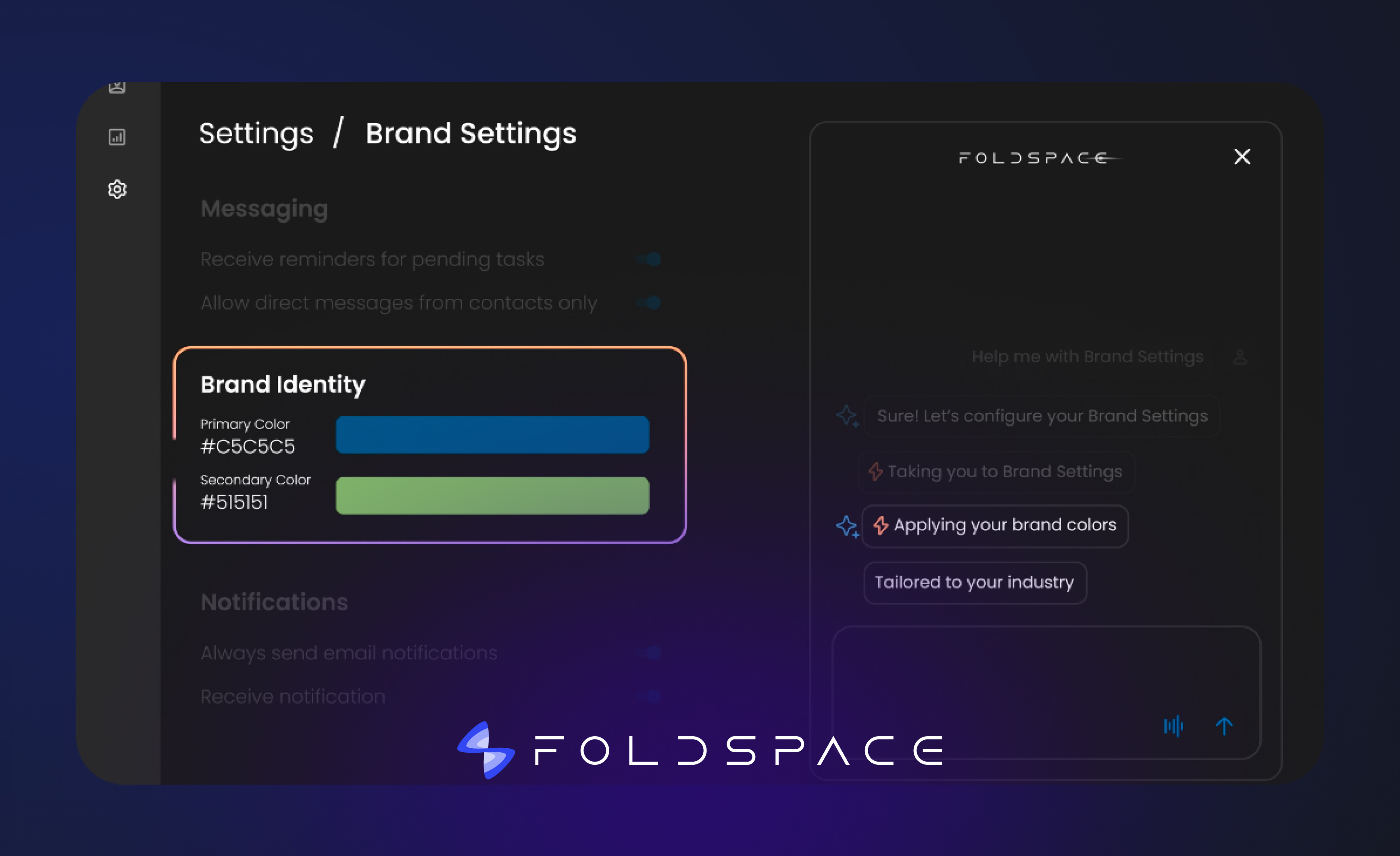
This post is brought to you by Foldspace
Foldspace is building what activation increasingly needs: an AI-native product experience that lets users act before they learn.
Instead of asking users to figure out where things live, Foldspace embeds an AI co-pilot directly into your product. Users simply express intent — import contacts, prepare for a meeting, move a deal forward — and the agent guides them through the UI or executes the workflow on their behalf.
Best way to support Growthmates? Explore more fantastic tools 👇
Framer — the fastest way to design and publish stunning websites (Growthmates.club is built on it).
Mobbin — the largest UX & UI reference library for deep product inspiration.
Obi by Cor — AI-powered onboarding voice assistant, I truly recommend.
Magic Patterns — The fastest way to prototype and test new features with AI.
Now, let’s dive into today’s story 👇
When nothing breaks, but belief never forms
Activation rarely fails loudly. It fails quietly when belief arrives too late.
Most SaaS products don’t lose users because they’re confusing or underpowered. They lose users because nothing meaningful happens early enough to keep curiosity alive. The first session is rarely about mastery. It’s about whether the product makes sense before it asks for effort.
In those early moments, users aren’t evaluating feature depth. They’re orienting themselves. They’re trying to understand whether this product fits into their world at all.
Users are silently asking:
Do I understand what this product is for?
Does it feel relevant to me?
Can I imagine myself succeeding here?
If the product can’t answer these questions quickly, onboarding doesn’t technically fail. Users simply disengage — not because something went wrong, but because nothing compelling happened soon enough.
Why the first minute is about confidence, not the full “aha”
Activation discussions often focus on the full “aha moment.” But for most products, that moment naturally takes time. Collaboration tools need collaborators. Analytics tools need data. Complex workflows need repetition.
That doesn’t mean the product should feel empty at the start.
What matters in the first minute is not full value, but confidence. Users don’t need proof that the product will solve everything. They need a believable signal that it can solve something — and that they’re capable of using it.
You can see this pattern clearly outside of onboarding, too.
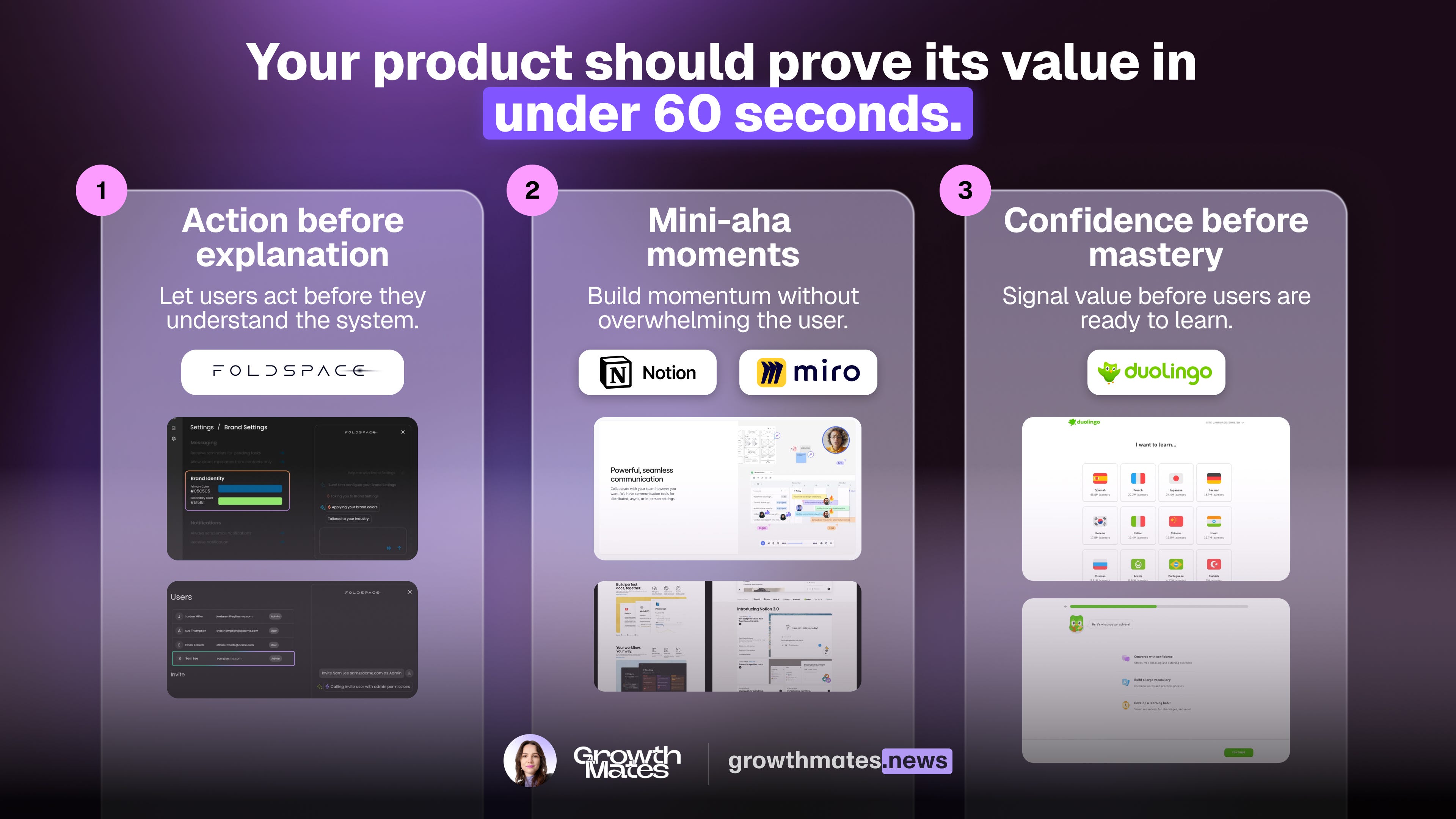
When Miro introduced Intelligent Canvas, the goal wasn’t to make users productive in 60 seconds. The page leads with concrete, familiar scenarios — sprint planning, retrospectives, team workshops — so intelligence feels collaborative, not abstract. Before users try anything, they already understand where this fits in their work.

Notion made a similar shift over time. Earlier versions explained what the product was made of: notes, docs, databases. Today, the site speaks in outcomes: “You assign the task. Your agent does the work.” The first interaction isn’t about learning Notion — it’s about imagining yourself succeeding with it.

This is why time-to-first-value is being reinterpreted. Not as compression, but as direction. Confidence forms when users feel guided rather than tested, and when early progress is visible before commitment is required.
Mini-aha moments exist for this reason. Not as demos, but as confidence builders. When users feel “this can help me,” they’re willing to invest time and move toward deeper value.
When software stops teaching interfaces — and starts acting with users
AI changes activation in a meaningful way when it removes translation work from the user.
Traditional onboarding assumes users must first learn the product. Where things live. How workflows are structured. Which buttons matter. But many users don’t want to learn a system before they see results. They want results first, and understanding later.
That’s what stood out to me when I tried Foldspace.
Instead of being introduced to the interface, I could immediately express intent. Import contacts, view an account, or move a deal forward. Prepare for a meeting. The product acted with me, without requiring me to translate my goals into UI steps.
Foldspace earns belief in the first minute because it:
Removes the need to understand the interface
Lets users act before learning the system
Shows outcomes before explanations
Activation happens not because the product is simpler, but because the user never has to ask where to start.
This idea isn’t new — Duolingo solved it without AI
AI isn’t the only way to earn belief early. Some products have been doing this long before AI entered the picture.
Duolingo is a clear example. I recently shared a breakdown of Duolingo’s onboarding on LinkedIn — and honestly didn’t expect it to resonate this much. But the reaction made sense. What Duolingo gets right is not motivation or gamification in isolation. It’s the emotional state they create in the first 60 seconds.

Within the first minute, you haven’t learned a language. But you’ve learned something more important: you’ve started, you didn’t do it wrong, and you can keep going.
It doesn’t test users. It reassures them. That shift — from hesitation to momentum — is what makes long-term retention possible.
Here are some examples of how Duolingo earns belief early, step by step:
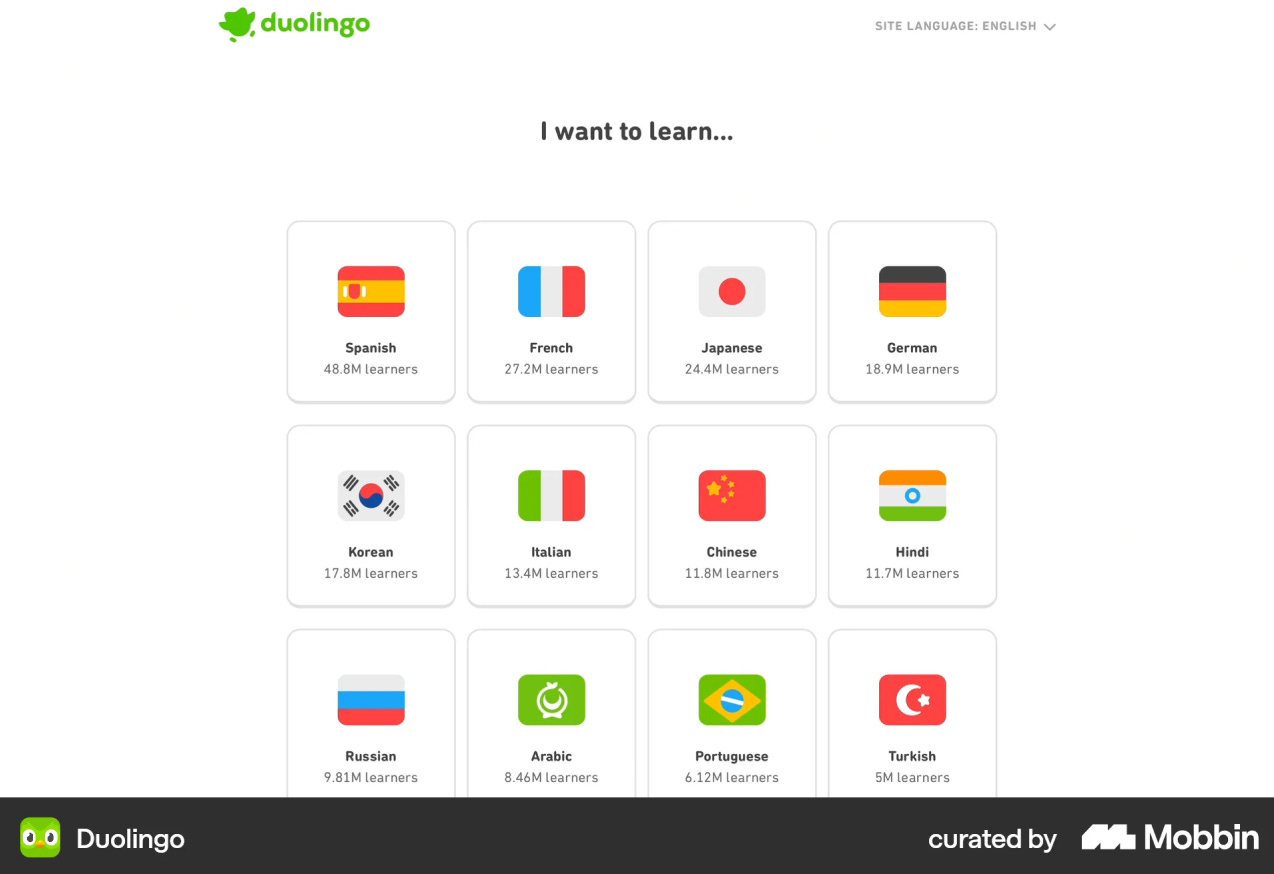
1. It removes the blank page immediately
The first decision is easy: pick a language. No account friction. No long forms. You’re in motion within seconds.
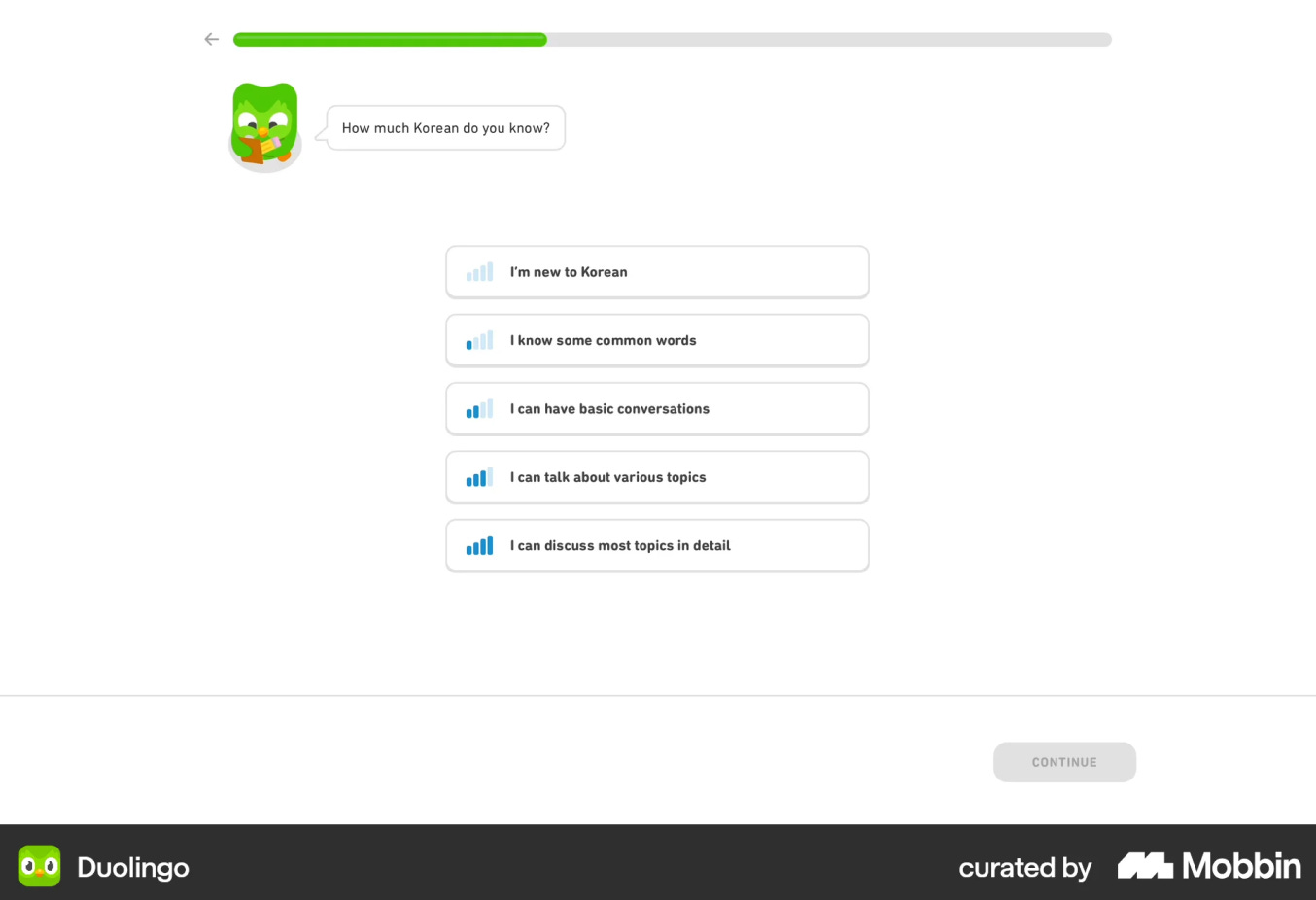
2. It asks questions that feel supportive, not extractive
“Why are you learning?” “How much do you already know?”. It doesn’t feel like data collection. It feels like the product is trying to meet you where you are.
3. It sells the payoff before asking for effort
Before lesson one, Duolingo shows what you’ll gain by continuing — creating motivation before commitment.
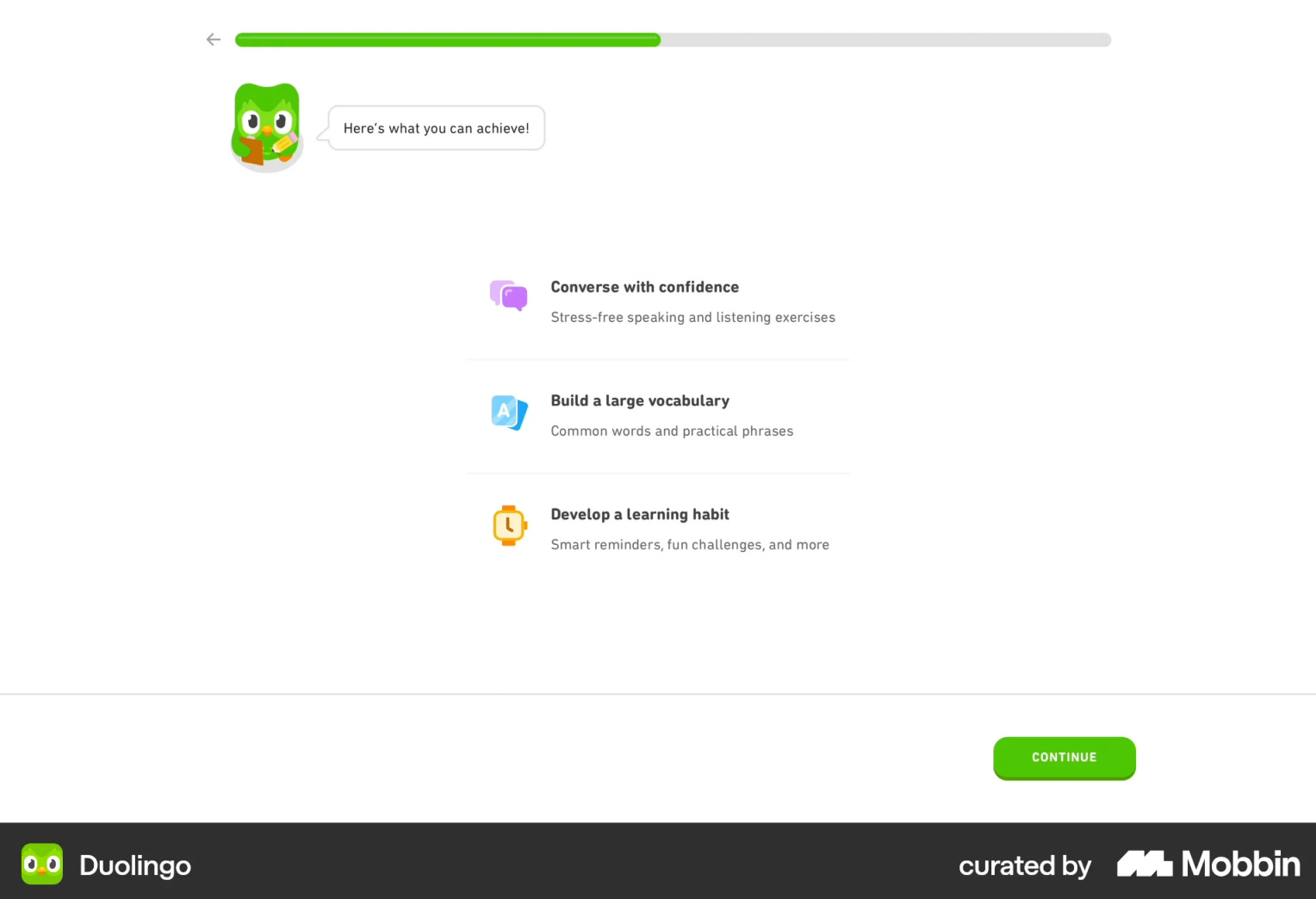
Duolingo doesn’t test users. It reassures them.
All of the screens in this flow were pulled from Mobbin, which continues to be my go-to source when I want to study onboarding patterns that actually work.
👉 You can see the full visual breakdown in the carousel — and the original post here:
The 60-second activation checklist
You don’t need benchmarks or dashboards to explore this in your own product. You can sense it by looking at the experience itself.
Ask:
Can users do something meaningful without knowing where things live?
Does the first interaction reduce fear or introduce it?
Is progress visible before commitment is required?
Does the product behave more like a guide — or a manual?
These questions apply beyond onboarding screens. They touch product structure, naming, defaults, and increasingly, how AI is embedded into workflows.
What this means for modern PLG teams
Across all the examples in this issue, from onboarding flows to AI copilots, one pattern keeps repeating.
Products don’t lose users because they’re hard to use. They lose them because the early experience doesn’t help users orient themselves.
Time-to-first-value is evolving. It’s no longer just about speed. It’s about orientation, confidence, and trust.
The products that win the next phase of product-led growth won’t be the ones with more onboarding steps or clever walkthroughs. They’ll be the ones who earn belief early and allow value to reveal itself progressively.
Because if belief doesn’t form in the first minute, users rarely stay long enough to discover what the product can really do. Designing for the first minute isn’t about speeding users up. It’s about helping them feel grounded — so they’re willing to stay and discover the rest.
🤝 Would you like to work with Growthmates in 2026?
Over the last few years, Growthmates has intentionally moved toward deeper, more focused collaborations — the kind where there’s time to think, challenge assumptions, and build something meaningful with a team, not just for them.
That’s the energy I’m taking into 2026. Because of this, I’m keeping my client work deliberately small and focused. Q1 will be the only window for 1:1 work for a while.
If you’ve been thinking about strengthening your onboarding, activation, or PLG foundation — this is likely the right moment. Here’s what I’m opening up for Q1:
Onboarding Design Sprint 🏃♀️
I will work closely with your team to help you fix your product growth challenges and improve the first user experience that can drive x2 uplift on your Activation.
👉 Work with me → (only 1 slot till April 🔥)
PLG Advising for your company 🧠
Hands-on, in-depth advising across product, UX, and growth to build a scalable, sustainable PLG system that will last for years.
👉 Work with me → (only 1 slot till April🔥)
PLG Training for your team 🎓
A structured PLG training using the same frameworks I’ve taught teams at Grammarly, Autodesk, Monday.com, Intercom, Atlassian, and more.
👉 Work with me → (2 slots till April 🔥)
Brand Partnerships 📩
Let’s tell your product story to a trusted audience of 30,000+ product, design, and growth leaders — and co-create meaningful content that inspires the wider product and design community.
👉 Send an inquiry to hello@growthmates.club (2 slots till May 🔥)
Premium Edition 💎
If you’re getting value from this newsletter, get access to full archive with more frameworks, teardowns, and exclusive content on PLG, Activation, AI, and how to build meaningful products that delight users.
👉 Upgrade to Premium and get full access.
This is all for today, dear readers. If you found this helpful — please share your reaction and leave some comments 💜 It would give a huge support for me to continue creating this!
If you find this newsletter valuable, share it with a friend, and consider subscribing if you haven’t already. There are some discounts available, and maybe you can expense this :)
Connect with me on LinkedIn and learn more about my work on Growthmates.club.
With best regards,
Kate Syuma