PLG 2025 Rewind: Biggest trends and major updates.
How onboarding evolved, what actually moved PLG, how AI reshaped UX, and more.
Hello everyone 👋 I’m Kate Syuma, and welcome to Growthmates.news — the newsletter where we explore growth stories to inspire your professional and personal growth. Join the community of 7,300+ Product, Design, and Growth people from companies like Amplitude, Intercom, Miro, Atlassian, Grammarly, Framer, and more.
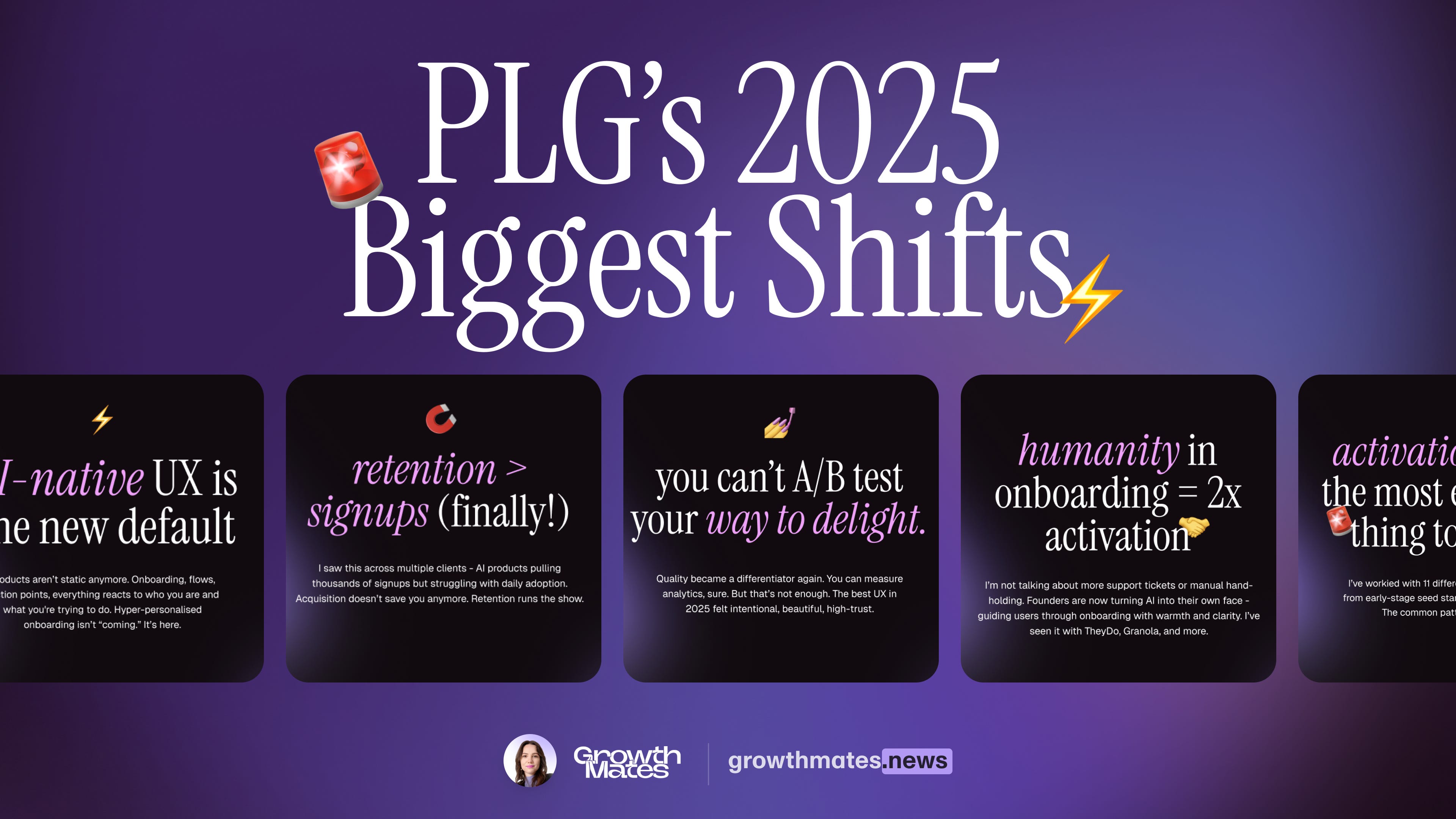
2025 felt like the year PLG quietly rewired itself. After dozens of product reviews and advisory sessions, one pattern kept repeating for me: PLG is evolving faster than expected, and even last year’s playbooks already feel outdated.
Onboarding got more human (ironically, thanks to AI), activation became harder to earn, retention turned into the #1 growth pain across AI and enterprise SaaS, and “shipping fast” finally stopped justifying forgettable products.
If 2024 was about “AI inside the product,” 2025 became the year AI started shaping the product experience itself.
Before we dive in… Meet Growthmates Partners 🚀
I curate the Growthmates Bundle to share not just ideas — but the tools I trust and use in my own work. Each one is a handpicked #1 tool for a key product area, and I’m proud to have them supporting this newsletter 🖤
Best way to support Growthmates? Explore these fantastic tools below 👇
Framer — the fastest way to design and publish stunning websites (Growthmates.club is built on it).
Mobbin — the largest UX & UI reference library for deep product inspiration.
Obi by Cor — AI-powered onboarding voice assistant, I truly recommend.
Magic Patterns — The fastest way to prototype and test new features with AI.
What you’ll learn today:
The biggest PLG shifts I’ve seen across 2025.
How onboarding and activation quietly got reinvented.
Why quality became the new growth lever (and why A/B tests couldn’t keep up).
What AI actually changed in UX — beyond the hype.
And what all this means for your roadmap in 2026.
Now, let’s dive into today’s story 👇
PLG’s Biggest Trends in 2025.
👉 AI-native UX is redefining PLG.
AI copilots, assistants, and adaptive onboarding became standard in B2B SaaS. Products now personalize experiences and predict friction before it happens. We’re talking about hyper-personalised onboarding and other flows as the future of PLG, and it’s getting closer, and more predictions like this.
👉 Growth teams’ headache is Retention, not more Sign-ups.
2025 shifted the focus from signups to revenue, driven by usage patterns, account-level intent, and strategic expansion. I literally saw this with my own eyes with clients — nailing acquisition doesn’t help anymore, and for AI products adoption (and deep long-term retention) is a daily headache.
👉 You can’t A/B test your way to “WOW” your customers.
Quality became a differentiator — not just in metrics, but in care. The best UX in 2025 felt intentional, beautiful, and high-trust.
You can’t A/B test your way to this kind of quality. I mean, you probably could measure that users with the fancy animation have slightly higher completion rates or whatever. But that’s backwards. The point isn’t that it performs better. The point is that someone cared enough to make it delightful.
Felix Haas mentioned in his recent post “Speed is not quality”.
There are more trends to unpack — let’s dive deeper 👇
Onboarding & Activation Shifts.
👉 Add humanity to your Onboarding = get x2 activation.
And I’m not talking about adding more human support — now AI can help with that. The AI is no longer a stranger if you turn it into your CEO’s face and let it walk customers through the flow with clarity and warmth.
Last year, I reviewed hundreds of onboarding flows — and one truth kept staring me in the face: most onboarding lacks humanity. But then I saw a very different approach.
I advised the Pyne.ai team early on, inspired by the idea that onboarding could feel like true hand-holding… but delivered by AI. Later, I watched how TheyDo put that vision into action.
Jochem van der Veer, CEO of TheyDo, turned their onboarding into a founder-led AI guide, powered by Pyne. Not a chatbot. Not a tour. A real, in-product “assistant” that speaks in his voice, adapts to user context, and guides teams to their core “Aha!” moment — their “Opportunity Matrix”.
🔗 Read more: How an AI-Powered “User Onboarding Agent” More Than Doubled our Activation Rate.
👉 Onboarding is becoming SMARTER, not just shorter.
Instead of static steps, onboarding now adapts to user behavior, roles, pace, and in-product signals. And the tools we’re seeing go far beyond checklists: AI video agents, voice assistants, adaptive demos, and now — something entirely new.
Recently, I tested a fresh onboarding format from Obi: a real onboarding call… but powered by AI.
It feels like joining a Zoom with a product expert — except it’s an AI that sees your screen, talks naturally, and builds the outcome with you. In the demo, it turned my LinkedIn profile into a superhero-themed website in Lovable — asking questions, reacting in real time, and polishing the UI along the way.
It’s not a scripted tour or a tutorial. It’s a hyper-personalized demo where the product gets built with you, step by step.
This is what the future of onboarding looks like: smart, adaptive, collaborative — and deeply personal. I’m curious to see what 2026 will bring for onboarding, but whenever I show these solutions to teams, they get surprised.
🔗 Read more: 5 AI Onboarding Tools That Will Redefine 2026
👉 Ignoring Activation is still the most expensive mistake.
I’ve been working with 11 different companies last year, from early-stage seed startups to large enterprises. The typical pattern is the same — teams are still ignoring activation problems. Not having a clear definition of Activation and not understanding their most important ICP deeply — both of which lead to long-term retention problems.
Reminder: Activated users have ≈2-5x higher long-term (80 days+) retention. 70-80% of fully activated users convert to paid. Should we continue to ignore this?
Elena Verna: Customers are willing to tell you about themselves during onboarding - so ask away!
🔗 Read more: I bet you are doing product activation all wrong.
AI & UX Shifts.
👉 AI Performance is your real way to reduce churn.
If AI is slow, unreliable, or misses the point, users try it once — and fall back to old habits. The winners start by increasing “AI visibility”, then focus on making one workflow actually work, every time. Adoption doesn’t come from hype — it comes from trust built through repeated performance.
🔗 Read more: Users try your AI Once… Then leave. Let’s change that.
👉 Quality of your AI Features mattered more than A/B Tests.
Teams invested in thoughtful, delightful product details — not just iterative tests. The products that won made AI feel intentional, fast, and genuinely helpful — where one great interaction mattered more than ten experiments. Craftsmanship, not constant testing, became the real growth lever.
🔗 Read more: How AI is ALREADY shaping the future for Products and UX
👉 Hyper-personalization became a UX Baseline, not a nice-to-have.
In 2025, products stopped onboarding “everyone” and started adapting to someone. When UX matches how users think, learn, and work, activation gets faster — and selling happens through experience, not persuasion. One-size-fits-all UX now feels broken.
🔗 Read more: Hyper-personalisation is the new PLG in Al era.
Pricing & Packaging.
👉 More tools charged based on outcomes, not users.
This week, Kyle Poyar shared a spicy take on AI pricing — and honestly, it feels like we’re entering a new era of “stop overthinking value-based pricing”.
PostHog’s simple model (AI infra pass-through + 20% markup, plus a small free tier) shows a direction: no seats, no complex outcome pricing — just honest token economics. It’s fair, easy to explain, and positions the vendor’s value outside the raw tokens.
👉 Showing pricing in Onboarding for AI products is a new norm.
Claude’s flow is a good example: a friendly warm-up (“for you or for a team?”), light segmentation, then a gentle reveal of Pro/Max before users hit limits. It doesn’t feel pushy — it feels helpful.
Why this works: users arrive excited. Some are ready to upgrade on Day 0. Surfacing pricing early (with care) reduces friction and guides the right buyers to a team plan faster.
🔗 Read more: How Top AI Tools Onboard New Users in 2025
👉 Pricing became infrastructure — not just a strategy doc.
AI made pricing messy: every API call costs something, every user behaves differently. In 2025, the smartest teams stopped treating pricing as a spreadsheet or slide deck.
They started building it like infrastructure — something observable, versioned, testable. Tools like Schematic emerged to give growth, product, and ops teams full control over monetization — without engineering bottlenecks.
As Rob Litterst put it: “The age of hardcoded pricing is over — monetization needs its own stack.”
🔗 Rob’s full post
Looking Forward:
⭐️ Your users aren’t leads — they’re your best growth team.
The most successful PLG companies in 2026 won’t treat users like conversion events. They’ll treat them like collaborators: asking for feedback, shipping what they need, and turning them into loud, proud advocates.
⭐️ If users can’t explain your product’s value to their boss, you’ve already lost.
In 2026, internal storytelling matters. PLG tools will need to help users sell the product internally — not just show dashboards, but show impact. Think: built-in ROI summaries, shareable “look what we accomplished” moments.
⭐️ The “Aha moment” is no longer the goal — the “Oh wow, it keeps doing that” moment is.
Getting users to value once isn’t enough. The real magic is when they keep coming back and say, “Wait, it does this too?” PLG in 2026 is about repeatable value, not just flashy first impressions.
P.S. I’m planning to create a deep dive on AI tech stack for PLG in tandem with Kyle Poyar’s Growth Unhinged — stay tuned to see selected tools breakdowns for activation, product analytics, pricing, user research, and more in February ❄️
🎯 Where all of this is pointing
If we zoom out, the patterns across activation, onboarding, pricing, and UX start to look surprisingly aligned. We’re moving toward products that:
Feel human from the first 30 seconds, not after a paid plan.
Earn activation by guiding, not gating, and make “Aha” moments predictable.
Price AI in a way that feels fair, transparent, and easy to upgrade into.
Explain themselves through AI copilots instead of dashboards.
Let users move faster with fewer decisions, more clarity, and just the right amount of personality
The throughline: Products are becoming less about features and more about experience architecture. AI is simply the layer that makes that architecture personal, adaptive, and scalable.
2026 will belong to teams who embrace this shift early — not by adding more AI features, but by redesigning the journey around them.
🤝 Would like to work together on PLG in 2026?
Over the last couple of years, I’ve been intentionally moving toward deeper, more focused work — the kind where there’s space to think, care, and go deep with a team. That’s the energy I’m taking into 2026 as well. Because of that, I’m keeping my client work intentionally small and focused, and Q1 will be the only window to work with me 1:1 for a while.
If you’ve been thinking about improving onboarding, activation, or your PLG foundation — this is the right moment. Here’s what I’m opening for Q1:
Onboarding Design Sprint 🏃♀️
I will work closely with your team to help you fix your product growth challenges and improve the first user experience that can drive x2 uplift on your Activation.
👉 Work with me → (only 1 slot for Q1 🔥)
PLG Advising for your team 🧠
Hands-on, in-depth advising across product, UX, and growth to build a scalable, sustainable PLG system that will last for years.
👉 Work with me → (only 1 slot for Q1🔥)
PLG Training for your team 🎓
A structured PLG training using the same frameworks I’ve taught teams at Grammarly, Autodesk, Monday.com, Intercom, Atlassian, and more.
👉 Work with me → (2 spots left for Q1🔥)
Brand Partnerships 📩
Let’s tell your product story to a trusted audience of 30,000+ product, design, and growth leaders — and co-create meaningful content that inspires the wider product and design community.
👉 Send an inquiry to hello@growthmates.club (2 spots left for Q1 🔥)
User-centric Growth Course 🎓
If these frameworks sparked new ideas — imagine working through your actual product challenge with my feedback, templates, and a dedicated community (AI will be there as well). This week, you can save 150$ for the enhanced program.
👉 Join with 150$ off → (5/10 discounted spots left for January ❄️.)
Premium Edition 💎
If you’re getting value from this newsletter, get access to full archive with more frameworks, teardowns, and exclusive content on PLG, Activation, AI, and how to build meaningful products that delight users.
👉 Upgrade to Premium and get full access.
This is all for today, dear readers. If you found this helpful — please share your reaction and leave some comments 💜 It would give a huge support for me to continue creating this!
If you find this newsletter valuable, share it with a friend, and consider subscribing if you haven’t already. There are some discounts available, and maybe you can expense this :)
Connect with me on LinkedIn and learn more about my work on Growthmates.club.
With best regards,
Kate Syuma


