


Hello everyone 👋 I’m Kate Syuma, and welcome to Growthmates.news — the newsletter where we explore growth stories to inspire your professional and personal growth. Join the community of 7,000+ Product, Design, and Growth people from companies like Amplitude, Intercom, Miro, Atlassian, Grammarly, Framer, and more.
AI is spreading fast. But it still feels awkward. Robotic. Duct-taped onto existing products.
We’ve all felt it — that moment when a smart new AI feature pops up in your workflow… and instead of feeling helpful, it interrupts your rhythm. Or worse, confuses you.
At first, AI felt like magic. Now we’re at a different point in the curve — one where users are starting to ask new questions.
Do I trust this?
Is this actually helping me?
Do I want to use it again tomorrow?
Before we dive in… This post is brought to you by Amplitude — the digital analytics platform that helps teams turn insights into action. Their new AI Agents work 24/7 to spot drop-offs, suggest optimizations, run experiments, and improve outcomes — all while keeping you in control 🤓

Want to collaborate on future content or share your product story? Check it out 👉
We used to celebrate AI just for existing. Now, it’s not just about whether you have it.
It’s about how it makes your users feel, and if they would like to come back and truly adopt it.
In the last few months, I’ve been looking around in search for examples where companies did an extra mile — not just integrated AI, but really thought deeper about user experience behind that will naturally foster activation and adoption.
Let’s see what I found 👇
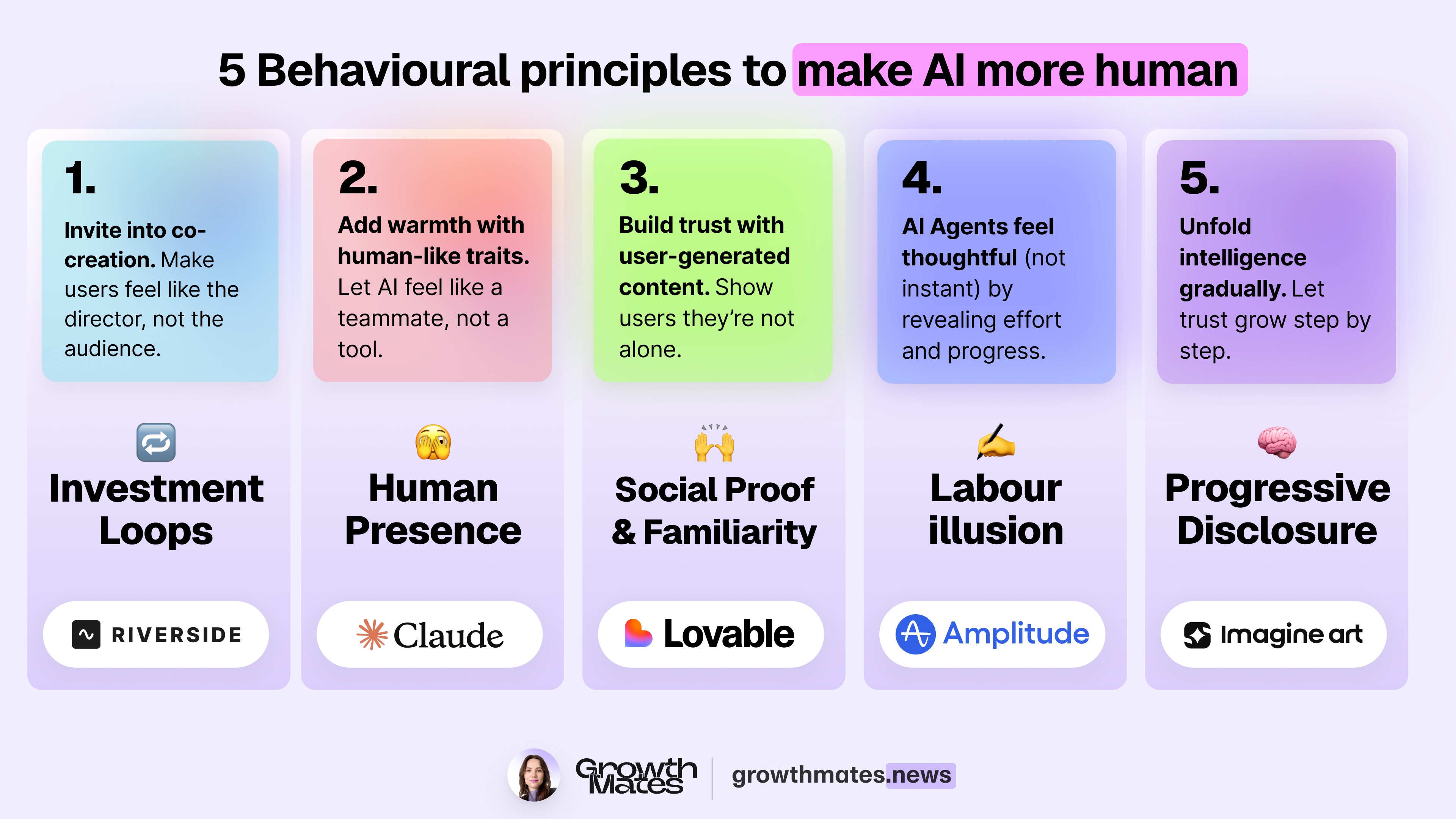
1. Investment Loops 🔁
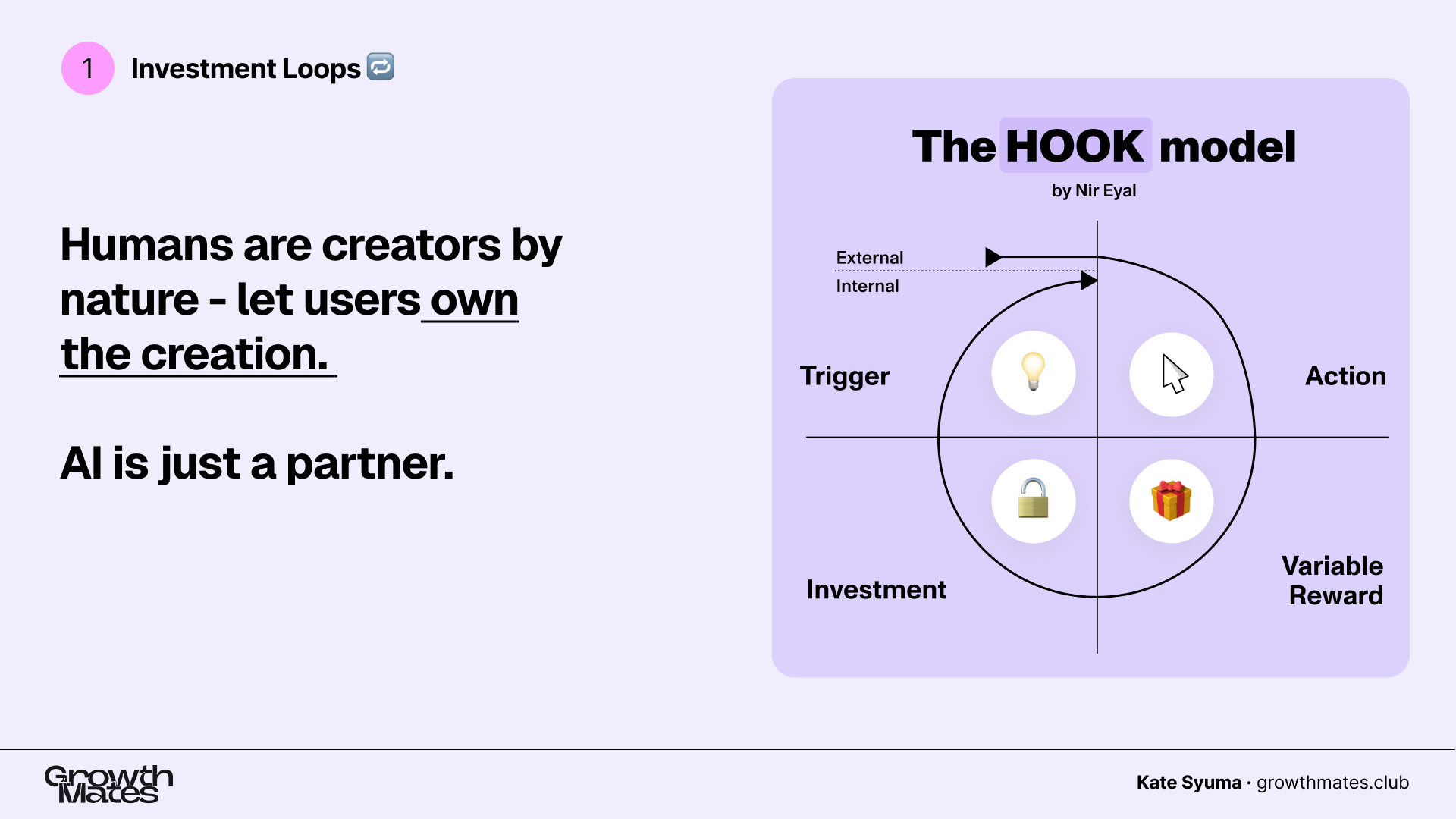
📌 Let users own the creation. AI is just a partner.
A lot of AI tools fall into the trap of trying to impress users with polished, one-click results. But magic wears off fast when the user isn’t part of the process.
That’s where the idea of investment comes in.
It’s a concept from the Hook Model by Nir Eyal (more in this article) — the idea that when users put effort into a product, they’re more likely to return. Not just because of the output, but because they helped shape it.
The best AI experiences don’t just serve answers. They invite users to co-create — to make decisions, add input, shape direction.
It’s not about making AI do everything for the user. It’s about giving the user more agency, with AI as the assistant.
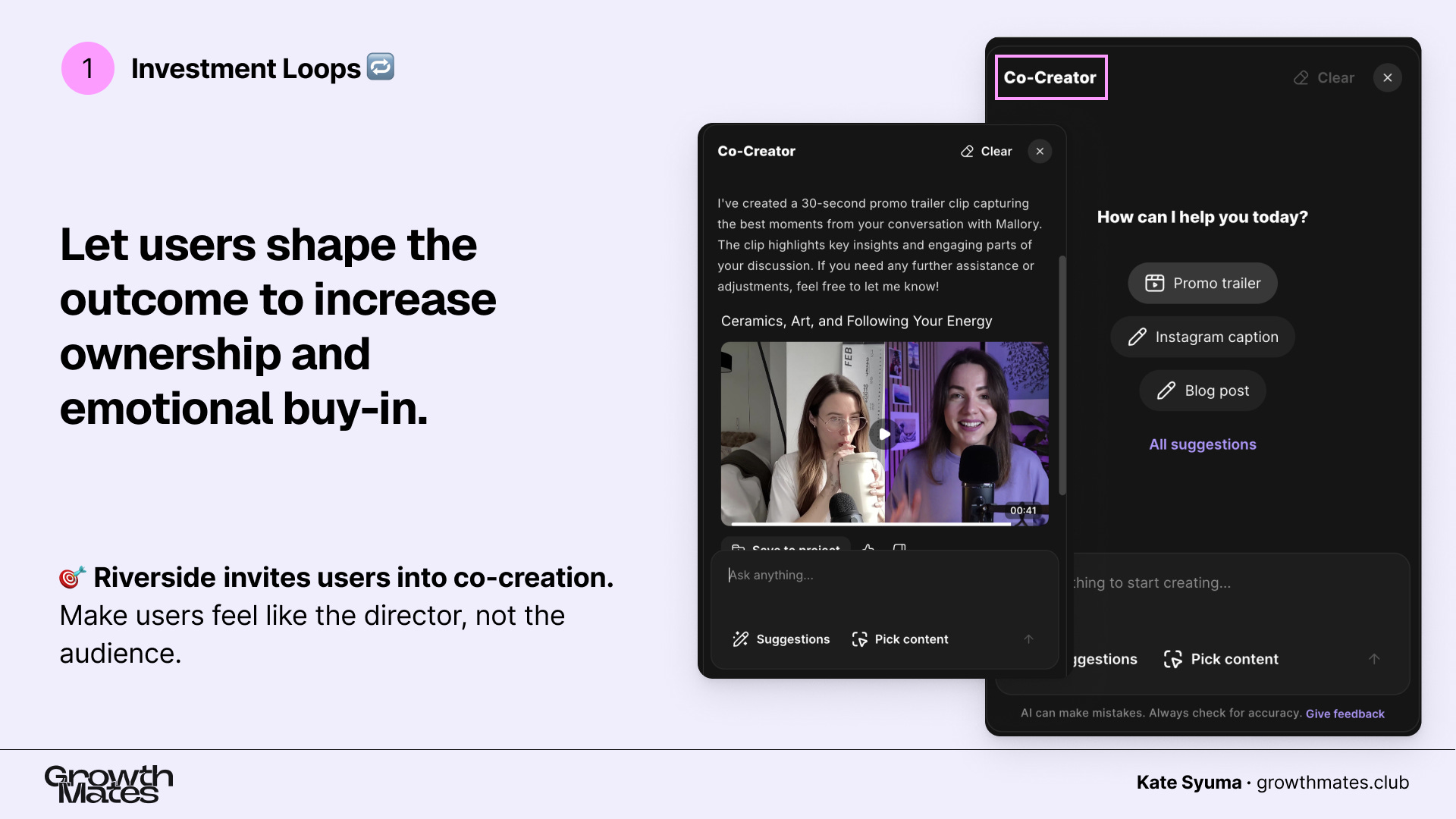
✅ Best Practice → Riverside “Co-creator“ mode.
Riverside is constantly evolving with AI. Instead of just auto-generating a trailer, it lets you guide the outcome. You pick the vibe. The focus. You say: “This is what I want to create.” That’s what builds emotional buy-in. The user isn’t just handed content — they see themselves in it.
That feeling? You value the outcome, as you helped to co-create this.
2. Human Presence 🫣
📌 Make the first experience personal and memorable.
First impressions matter. Especially with AI.
In traditional products, a clunky onboarding might lead to a 40–60% drop-off. With AI, it’s worse — robotic, awkward first interactions can drive away the majority of users for good. That’s why bringing human warmth into the first moments is critical. Not fake-human.
✅ Best Practice → Calude Onboarding.
Take Claude. Right from the start, it says: “Hi, I’m Claude.” Then it asks what you’re into — invites you to choose a few things. Not in a cold, dropdown menu kind of way. It speaks like a human to a human.

That tone builds trust. And it doesn’t stop after onboarding. Hover over Claude’s avatar any time, and you’ll get dynamic, personable intros: “I’m here to help.” “Need anything?” — like a friendly assistant, not a mysterious black box.
✅ Best Practice → Pine x TheyDo onboarding with AI avatars.
Now let’s talk about scaling that human feeling — especially in B2B or enterprise products, where onboarding is often complex.
One team used a tool called Pine to layer a real human avatar into the onboarding flow — in this case, the CEO of TheyDo (more in this article). The face you see isn’t a stock image. It’s a real person, trained on real context, welcoming you in.

The results? Activation shot up. Because it felt like someone cared.
And the beauty of it — this can scale. With AI-powered avatars, you can create variations, go beyond the CEO, personalize the flow for different users.
Because at the end of the day, people still want to feel seen. Even by software.