


Hello everyone 👋 I’m Kate Syuma, and welcome to Growthmates.news — the newsletter where we explore growth stories to inspire your professional and personal growth. Join the community of 7,600+ Product, Design, and Growth people from companies like Amplitude, Intercom, Miro, Atlassian, Superhuman, Framer, and more.
I’m stepping away for a bit (maternity leave 👶), and it feels like a summer break I haven’t had in more than a decade, and it won’t be a long one.
Before I do, I wanted to share what I’ve been quietly building behind the scenes.
Over the past 8+ years (from Miro to Growthmates), I’ve been collecting how the best products actually work: how they design onboarding, reduce friction, and drive activation in practice.
Recently, I finally turned that into something more structured — along with a few resources I wanted to leave for you while I’m away.
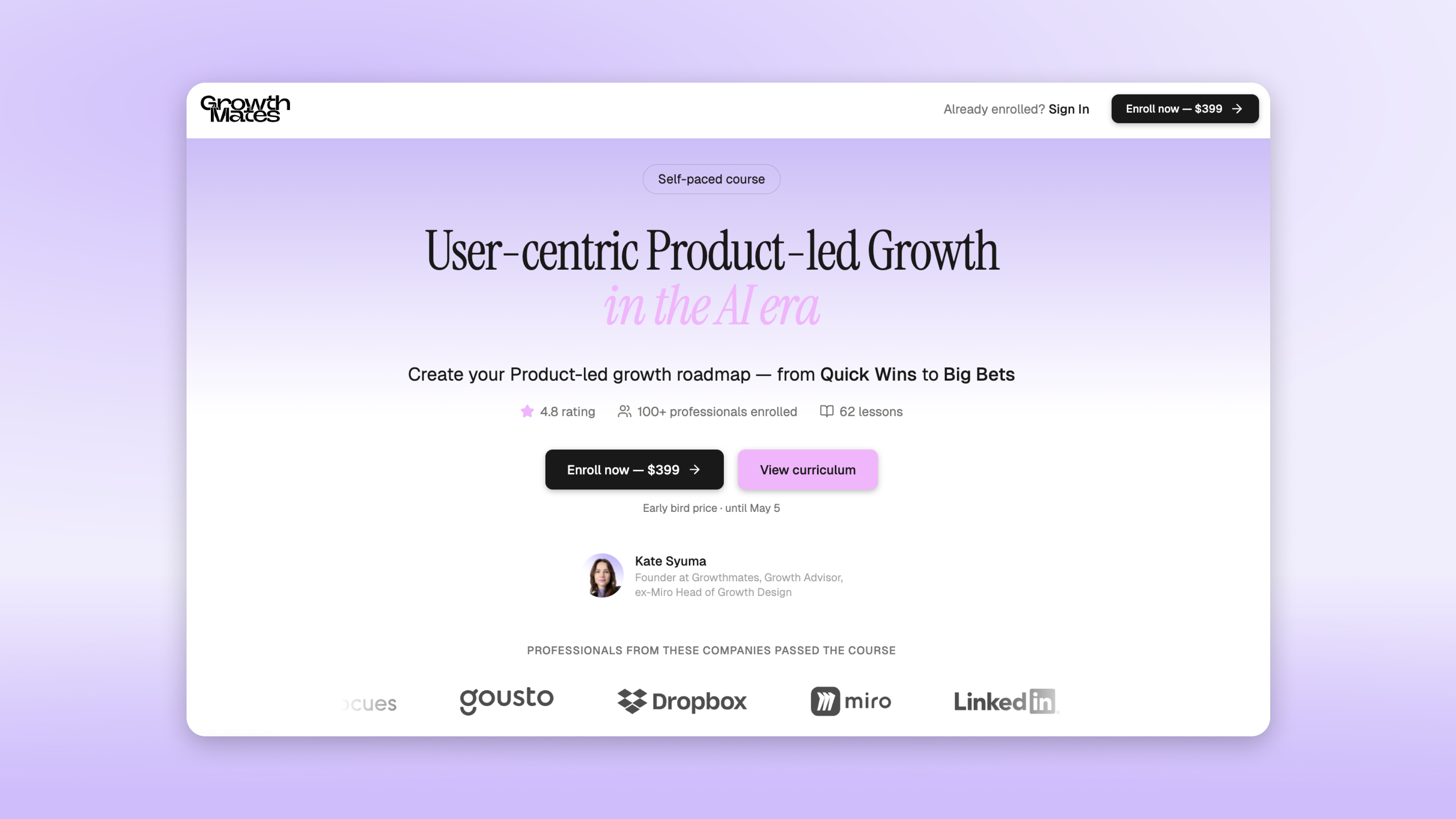
Here’s a sneak peek… We’ve built the Growthmates Academy for you 🎓
This post is brought to you by Pitch — a platform built for collaborative, on-brand presentation workflows.
I used Pitch to build my “Who is a Growth Product Designer” deck, and it made it easy to keep everything on-brand while working with others in real time. Features like the shared brand library and live tracked links remove the usual back-and-forth and make sharing much smoother. Instead of juggling versions and PDFs, everything stays in one place — and keeps evolving.

Best way to support Growthmates? Explore more fantastic tools 👇
Framer — the fastest way to design and publish stunning websites (Growthmates.club is built on it).
Mobbin — the largest UX & UI reference library for deep product inspiration.
Obi by Cor — AI-powered onboarding voice assistant, I truly recommend.
Magic Patterns — The fastest way to prototype and test new features with AI.
My biggest life transition — I’m stepping away for 6 months.
I don’t remember the last time I took a real break from work. But this doesn’t feel like a “career break.” It feels more like an expansion. A shift into something new.
Stepping into motherhood feels less like pausing and more like uncovering another layer of myself — of my identity, of how I think, what I care about, and what I want to build next. I’m genuinely curious what this period will change for me.
Even now, at 36 weeks, I’m still working — writing, creating, sharing. And it doesn’t feel forced, it feels rewarding. At the same time, I’ve started to consciously let go of a different kind of work: client projects, intensity, and constant output.

What I want instead is something simpler. The first months with the baby, time with my husband, and a slower summer. It almost feels like those school breaks we used to have — where everything paused, and the only thing that mattered was being present. That time already feels incredibly precious, and honestly, more important than anything I could be working on.
💡 It made me realize that most of the value we create is still tied to our presence — and I started asking myself a different question:
“What would it look like to build something that continues to be useful, accessible, and meaningful even when I’m not there to guide it in real time?”
That question stayed with me.
For years, I’ve been collecting knowledge — at Miro for over 6 years, and then through Growthmates, where for the past two years I’ve been constantly documenting patterns, product decisions, onboarding flows, and everything I’ve been learning along the way. But most of that value still lived “with me” — in conversations, in projects, in sessions.
And this moment made something very clear. I don’t want the value I create to depend entirely on me being there. I want it to exist beyond my presence, to be available anytime, and to keep being useful — even when I’m not here.
It was there for 2 years, so why did I launch this course now?
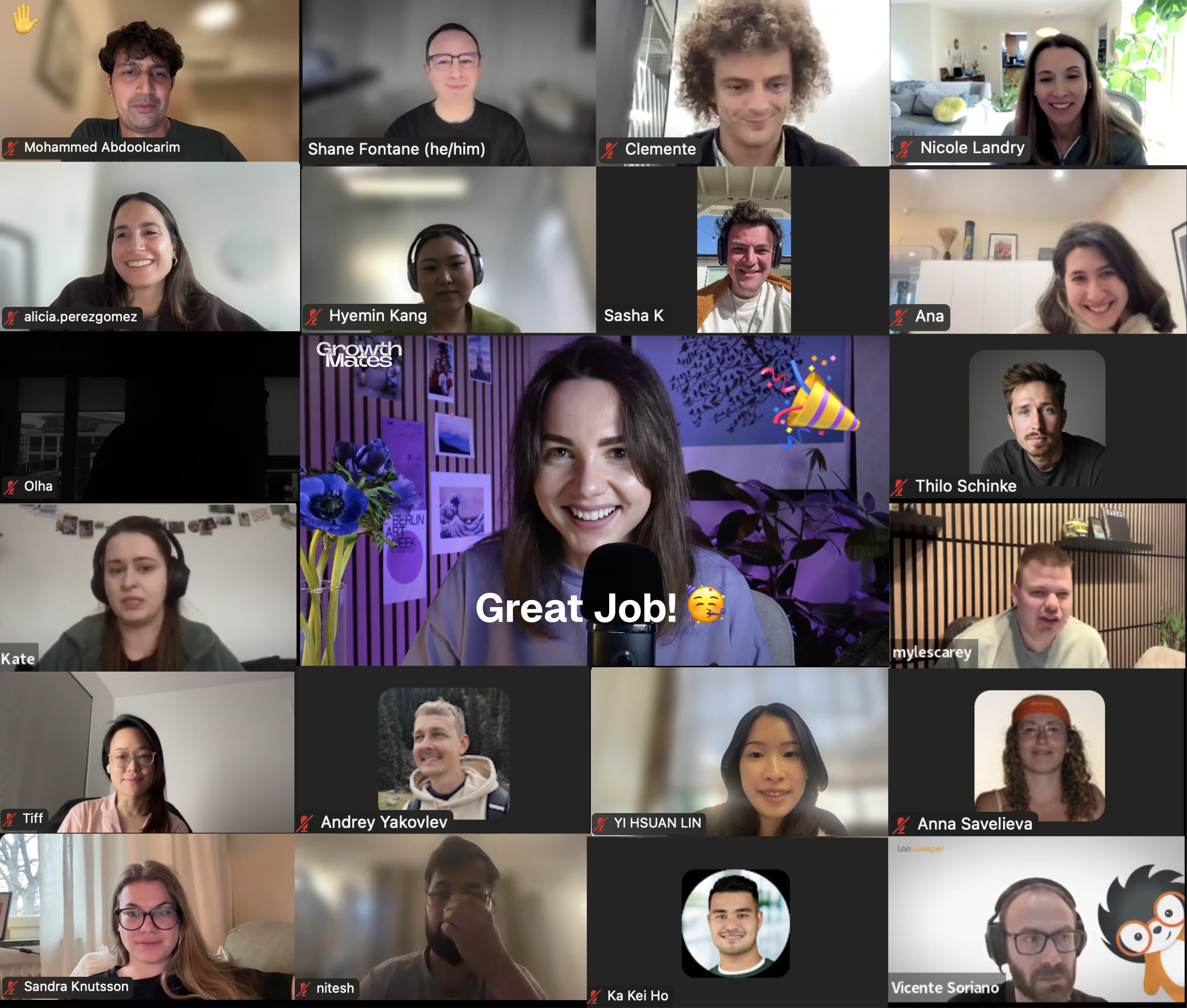
For the last couple of years, I’ve been teaching this course in a live format. Small cohorts, real interaction, workshops, discussions. It was one of the most rewarding parts of my work. You see how people think, where they struggle, what actually lands — and you adapt in real time.
That experience shaped a lot for me. It helped me refine the structure, understand what matters, and build confidence in how I teach and facilitate. In many ways, it became the foundation for everything I do today, including working with enterprise teams.
At the same time, the idea of turning this into something more scalable was always there. It just kept sitting in the background.
Every time I thought about building a self-paced version, a new reason to delay would show up. The market felt saturated. Another course didn’t feel necessary. I didn’t have a clear plan, or the time to do it “properly.” So I kept postponing it.
Until recently.
With motherhood, ongoing client work, and a long period ahead where I won’t be able to run live cohorts, something shifted. I realized I couldn’t rely on formats that require me to be present all the time. I needed something that could exist independently.
And suddenly, what felt like a huge, complex project became very simple. I stopped trying to plan everything perfectly and just started building.
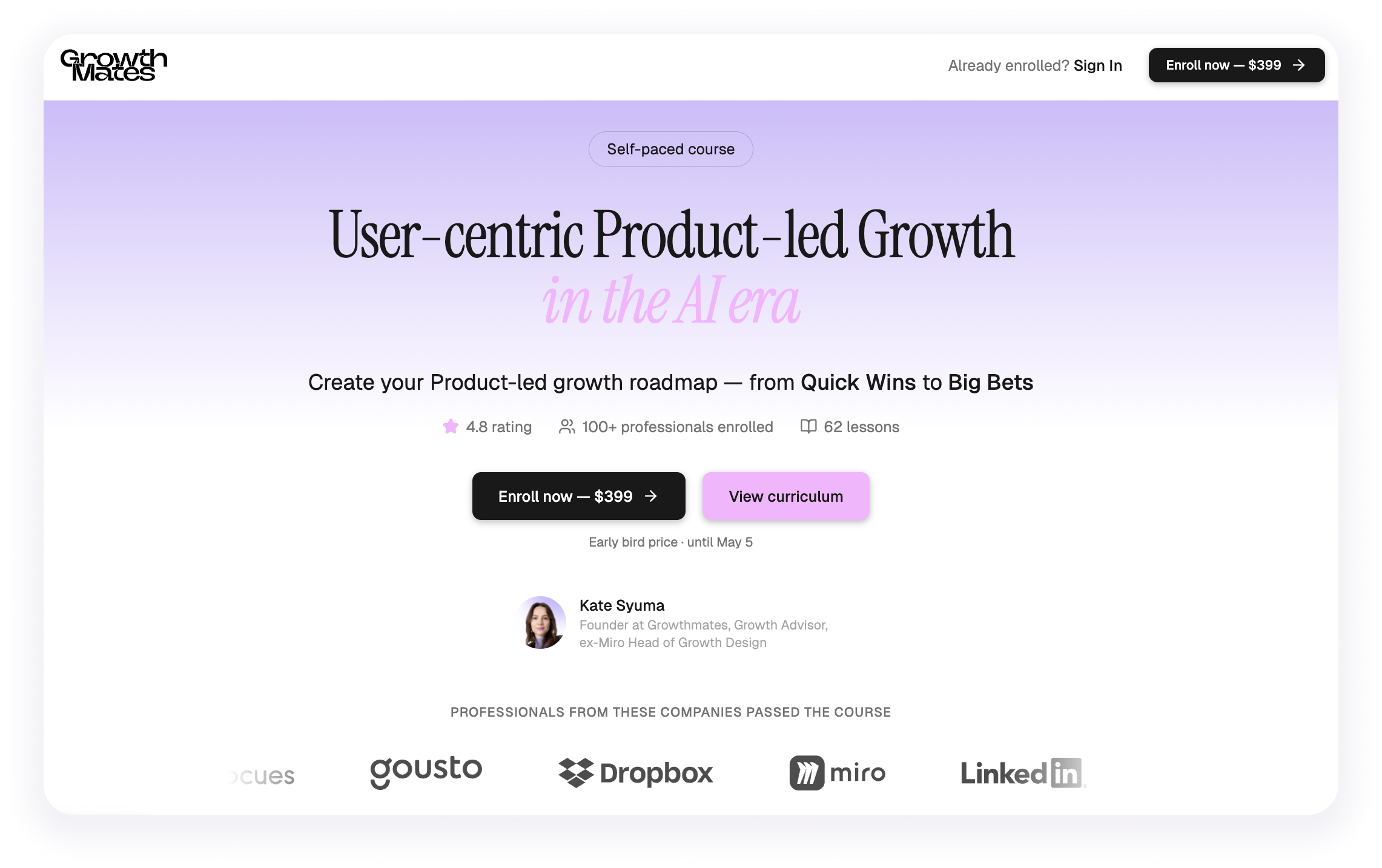
What’s interesting is that the course itself didn’t take two years to create. The packaging, the platform, the structure — that came together in a matter of weeks. But what’s inside was collected over much longer. Two years of refining the course, and more than eight years of experience behind it.
That’s the part you can’t rush.
💫 It made me realize that I wasn’t postponing the work itself — I was postponing the moment of making it real. And once I stopped waiting for the “right setup,” it became something I could actually finish.
There’s still a part of me that wants to come back to live formats. The interaction, the discussions, the shared thinking — that’s something I value deeply. I’m already thinking about what that could look like in the future, maybe in a different, more sustainable format.
But for now, this felt like the right version to create — something complete, accessible, and able to continue being useful without depending on me being there in real time.
I collected this knowledge for 8+ years, but you can get a shortcut.
Over the years, I’ve seen the same pattern repeat across teams.
A lot of effort goes into optimization — experiments, iterations, small improvements — but often within a very narrow frame. Product-led growth gets treated as something you layer on top, instead of something that should be built into the core product experience.
That’s where teams start moving in circles.
They improve conversion without improving clarity, test variations without questioning the structure, and keep optimizing flows that were never designed to create real value.
I started challenging this way of thinking a long time ago, back at Miro. Since then, I’ve been closely studying how the best product-led companies approach growth — Notion, Canva, Dropbox — and over time, this turned into a system.
🎓 It’s the kind of system I wish I had earlier in my career — not just to learn faster, but to stop solving the wrong problems.
That’s what I tried to package into the self-paced version of the course.
🎓 User-Centric Product-led Growth in the AI Era →
It brings together everything I’ve learned over the past 8+ years into a structured format you can actually use in your work. The focus is practical: real product flows, reusable frameworks, and templates you can apply directly to your own product.
Inside, you’ll find:
60+ lessons on user-centric PLG
29 deep-dive session recordings
30+ templates and practical resources
The course is already used by 100+ PMs and designers from companies like Dropbox, Miro, LinkedIn, and Revolut, and the feedback I hear most often is not about “learning something new,” but about finally seeing things more clearly.
You can go through it in a few weeks, or take it at your own pace and come back to it whenever you’re working on a new problem. It’s designed to be something you revisit — not something you consume once and forget.
Today is also the last day the course is available at the early launch price of $399, which is around 70% lower than the original $1,199 live version.
P.S. If you’re working with a team and want to use it as a shared resource, you can also reach out to me at support@growthmates.club — I’m happy to help set that up.
What I’m leaving behind — 6 more free resources while I’m away for 6 months.
Over the past year, I’ve been sharing something for free almost every month. Not just quick posts, but full collections of product examples, screenshots, and practical insights — the same kind of thinking I use in client work.
The intention was always simple. If I’ve already done the work of collecting and structuring this knowledge, it should be accessible to more people.
Since I won’t be able to share consistently for a while, I wanted to bring everything together in one place. So below, you’ll find my recent resource that covers different parts of the product journey — from the first interaction to onboarding, activation, and upgrades. Each of them is built around real product patterns you can learn from and apply directly.
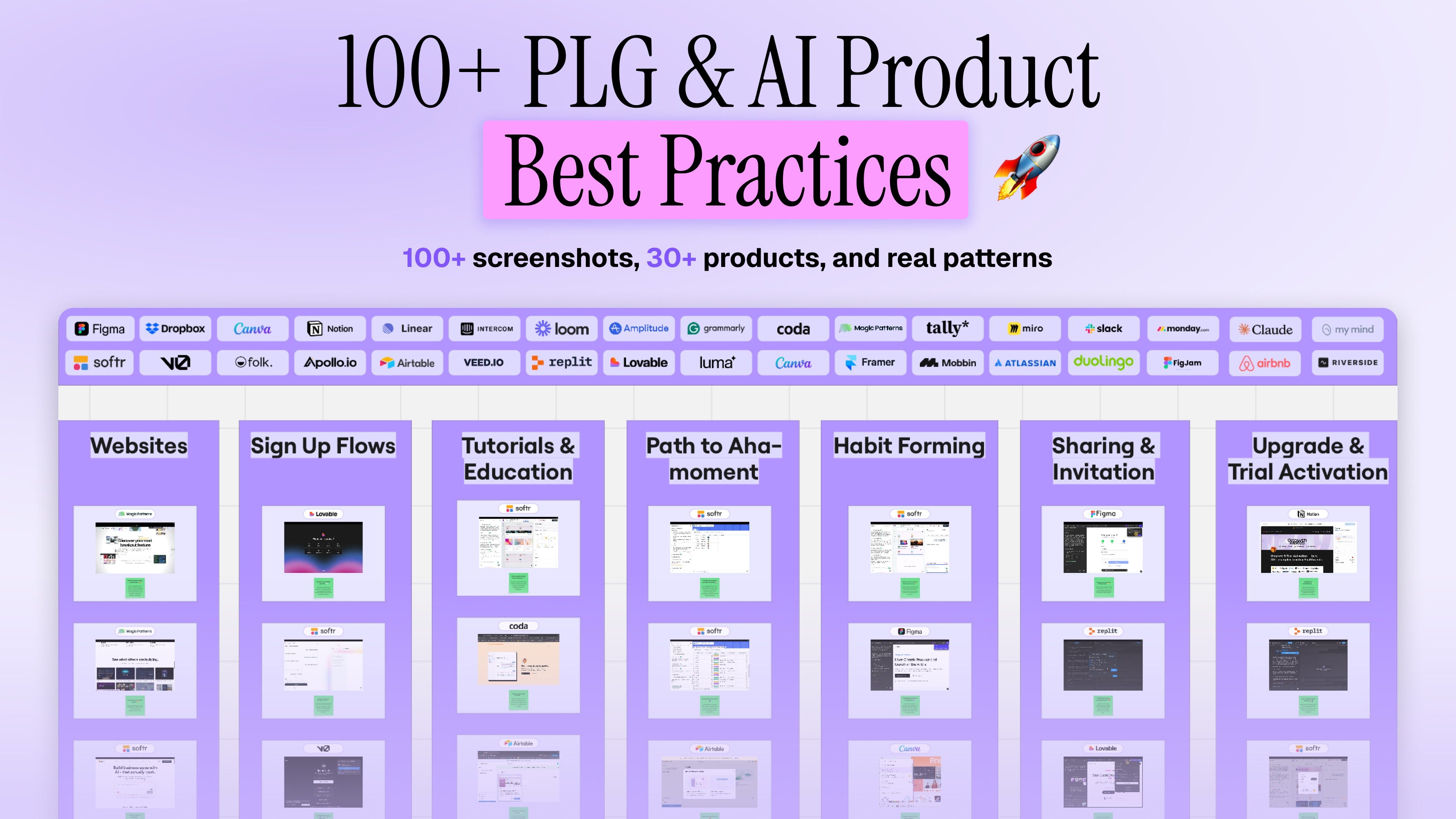
1. Free Miro Board with 100+ PLG and AI Best Practices.
Meet the ultimate collection — your shortcut to PLG best practices I’ve been collecting for years. Each section includes real product screenshots + notes from me. PMs, founders, designers, growth teams - this is for you.
If you want to go deeper, this is exactly what I’ve structured inside the User-Centric Product-led Growth in the AI Era.
It brings together 8+ years of experience into a system you can actually use — with real product breakdowns, clear frameworks, and templates designed to help you move from quick wins to bigger product decisions. Instead of learning everything through trial and error, you get a structured way to see what matters, where to focus, and how to improve your product over time.
🤝 Ways to collaborate with Kate & Growthmates:
Onboarding Design Sprint 🏃♀️
I will work closely with your team to help you fix your product growth challenges and improve the first user experience that can drive x2 uplift on your Activation.
⚡️ Fully booked. Join a watlist →
PLG Advising for your company 🧠
Hands-on, in-depth advising across product, UX, and growth to build a scalable, sustainable PLG system that will last for years.
⚡️ Fully booked. Join a watlist →
User-centric PLG in AI Era Course 🎓
A self-paced course built on the same frameworks, templates, and product breakdowns I used while leading growth at Miro and advising teams like Grammarly and Amplitude — now structured to help you build your own PLG roadmap.
Brand Partnerships 📩
Let’s tell your product story to a trusted audience of 30,000+ product, design, and growth leaders — and co-create meaningful content that inspires the wider product and design community.
👉 Send an inquiry to hello@growthmates.club
Premium Edition 💎
If you’re getting value from this newsletter, get access to full archive with more frameworks, teardowns, and exclusive content on PLG, Activation, AI, and how to build meaningful products that delight users.
👉 Upgrade to Premium and get full access.
This is all for today, dear readers. I’ll be stepping away for a bit for maternity leave — a short pause, but a very special one — and I’ll be back in the fall with fresh ideas, new perspectives, and more in-depth content to share.
If you found this helpful, please share your reaction and leave a comment 💜 It means a lot and helps me keep creating things that are truly useful.
If this newsletter has been valuable for you, feel free to share it with a friend, and consider subscribing if you haven’t already. There are also some discounts available — and maybe you can even expense it 🙂
Connect with me on LinkedIn and learn more about my work on Growthmates.club.
With best regards,
Kate Syuma
doubleee congratulationsss!!