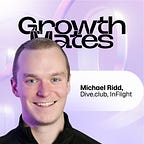

When I was at the very beginning of what later became my own “Creator’s path” I met Michael Ridd. At that time, I didn’t even have language for what I wanted to explore. There was only a quiet curiosity about building something of my own. Watching what Michael was creating gave that curiosity direction.
In 2023, he introduced me to Maven — which eventually led me to launch my course User-Centric Product-Led Growth in the AI Era. Since then, the course has scaled to 100+ professionals from companies like Atlassian, Dropbox, Miro, and more.
That same year, Michael left Maven, where he had been a founding designer, and doubled down on his creative path. He built Figma Academy, launched Dive.club, and began developing his own 0→1 product.
From the outside, it looked bold and decisive. From the inside — as we discuss in this episode — it required discipline, consistency, and a willingness to commit to the long game. I was also honored to be a guest on his Dive podcast (We’ve added this to the resources below.)
This time, when we recorded again, the conversation went in a different direction.
Brought to you by:

This episode is supported by tools I genuinely use and recommend:
Mobbin — the largest UX & UI reference library for deep product inspiration.
Obi by Cor— AI-powered onboarding voice assistant, I truly recommend.
Listen on YouTube, Spotify, and Apple Podcasts
Welcome to the season of Growthmates — The Creator’s Path
This episode of Growthmates — The Creator’s Path is about what happens after momentum.
We didn’t talk about acceleration. We talked about friction — about what actually starts breaking when companies scale and why most founders misdiagnose the problem. Not because they lack experience. But because complexity is quiet at first.
Anyone who has scaled beyond early-stage chaos has felt this. More customers don’t just generate more revenue — they generate more exceptions, more edge cases, more coordination costs, and more decisions that no longer fit the original structure.
From the outside, it looks like growth. From the inside, it often feels like slowdown.
And that’s where structural clarity becomes more important than speed.
Structural clarity over surface growth
This episode isn’t about branding, performance marketing, or growth hacks. It’s about operating models, decision rights, and the invisible tax companies pay when ownership becomes blurred and incentives drift apart.
Michael has spent years working with scaling organizations, and one recurring pattern keeps showing up: companies add people faster than they add clarity — and then wonder why speed disappears.

That distinction feels simple, but it explains so much. Strategy decks don’t scale companies. Decision architecture does.
Without clear decision rights and explicit trade-offs, teams optimize locally instead of systemically. Marketing optimizes for leads, product optimizes for features, sales optimizes for revenue — and no one optimizes for coherence.
Growth doesn’t create structural problems. It exposes them.
From selling time → to building leverage
We also revisited Michael’s personal shift — from selling time to building leverage.
He once described the turning point as a simple but powerful realization: distribution compounds. He didn’t have a perfectly formed startup idea, but he understood that showing up consistently would create optionality.
For six months, he woke up at 5 AM, opened Figma, created something, and shared it. No guarantees. No immediate payoff. Just signal gathering and repetition.

As he put it:
“I got a little bit militant actually — and it kind of worked.”
Michael Ridd, (Dive.club, InFlight)
That consistency eventually evolved into Figma Academy, then Dive, and later into building a product from scratch.
Building energy, not just optics
One of the most surprising parts of Michael’s journey is that Dive didn’t start as a podcast. It began as an advanced design school that generated over $1M in course revenue. On paper, it worked.
Behind the scenes, however, it was operationally chaotic.
When Michael began recording conversations with instructors, something shifted. It felt energizing. Instead of optimizing for what looked good externally, he started optimizing for what sustained him internally.
The podcast was first tested as a gated lead magnet — and thousands of people signed up just to listen. That was signal. Then came commitment: over 120 consecutive weeks of publishing.
Because when something gives you energy, you can stay in the game long enough for compounding to happen.
Creator and founder are not opposites
Another theme we explored is the blurred line between creator and founder.
Michael challenged the idea that these are two different identities. As software becomes cheaper to build and AI lowers technical barriers, ideas and distribution become primary leverage. In that world, creators are not “adjacent” to startups — they may be the most strategic co-founders.
His podcast became more than content. It became:
a learning engine;
a network magnet;
a long-term distribution asset

And now, as he builds his product, that distribution becomes a structural advantage.
The long game
We briefly touched on algorithms, platforms, and content formats. But the deeper theme of this conversation is much simpler:
You have to choose a game you’re willing to play even when nothing happens. Because for a long time, nothing does.
And then if you’ve designed well — everything compounds:
Reputation compounds;
Distribution compounds;
Skill compounds;
Trust compounds.
But none of it compounds in public at first. It compounds quietly — in drafts no one sees, in ideas that don’t land yet, in small signals that feel almost invisible.
This episode is a reminder that the real advantage isn’t speed. It’s staying and designing your path in a way that makes staying possible.
Best way to support Growthmates? Explore more fantastic tools 👇
Framer — the fastest way to design and publish stunning websites (Growthmates.club is built on it).
Mobbin — the largest UX & UI reference library for deep product inspiration.
Obi by Cor — AI-powered onboarding voice assistant, I truly recommend.
Magic Patterns — The fastest way to prototype and test new features with AI.
🤝 Want to collaborate with Kate Syuma and Growthmates?
Explore collaboration with Growthmates here: https://growthmates.club/services
User-centric PLG in AI era course — join waitlist for future cohorts and get 100$ off: https://maven.com/growthmates/user-centric-product-led-growth?promoCode=growthmates
Follow Growthmates updates on:
Growthmates website with “The Holistic Growth Playbook”: https://growthmates.club
Substack Newsletter (for instant inbox delivery):
Instagram: https://www.instagram.com/growthmates/
X (Twitter): https://twitter.com/kate_syuma
Where to find Kate Syuma:
Newsletter: https://www.growthmates.news/
Where to find Michael Ridd:
Dive Club: https://dive.club
Inflight: https://inflight.co
Twitter: https://twitter.com/ridd_design
LinkedIn: https://linkedin.com/in/michaelriddering
Figma Academy: https://figma.academy
Dive Club Ep. 30 with me: https://www.youtube.com/watch?v=np4ujOy1Yhw
Thank you for listening! Subscribe to the show on growthmates.club and get the free playbook with frameworks and insights.
If you’re enjoying the show, we’d love for you to leave a 5-star review on Apple Podcasts and Spotify. Your support helps us reach more listeners like you 💜
For sponsorship and other inquiries, reach out to hello@growthmates.club
Let’s keep growing together!