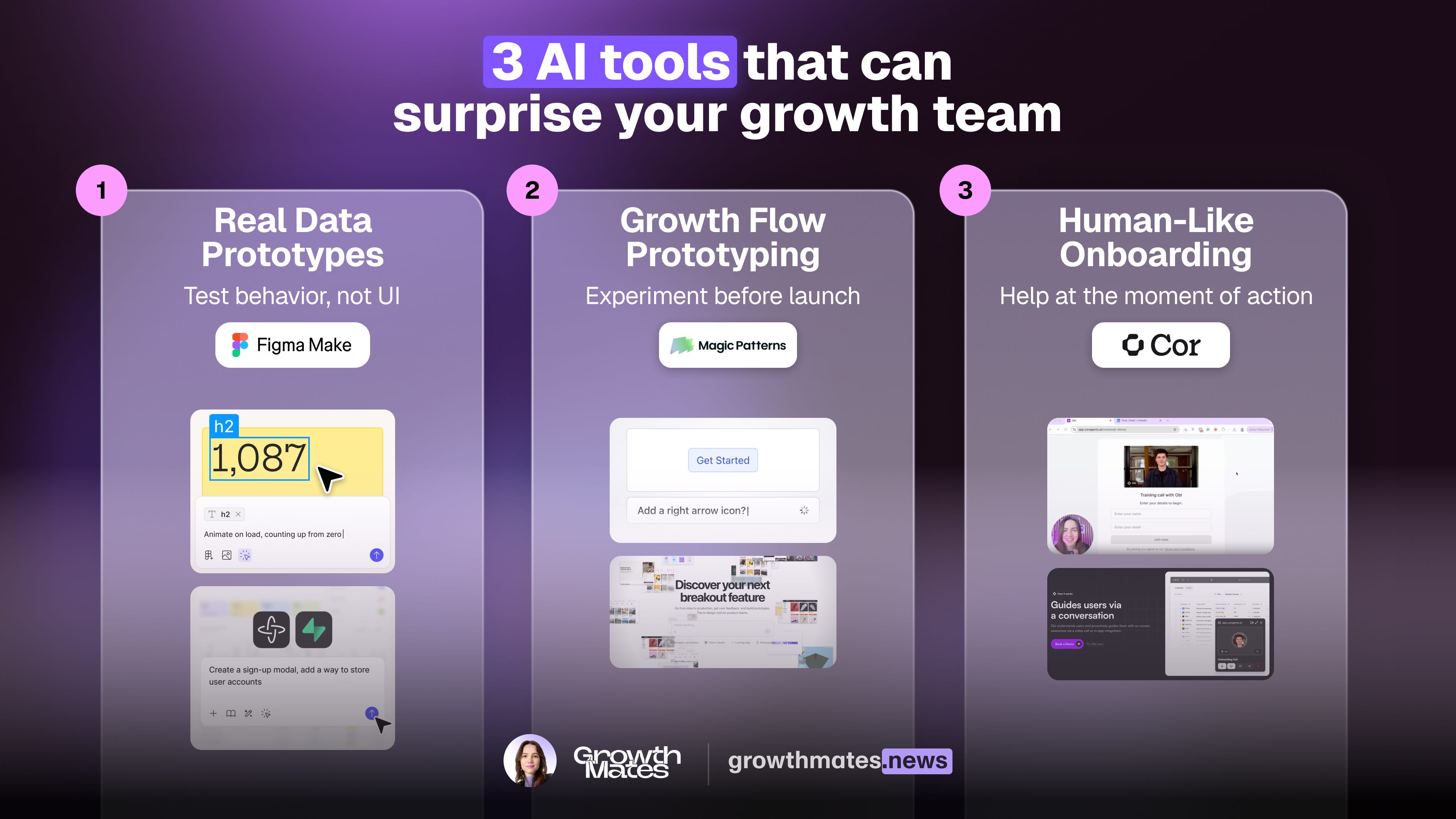
3 AI tools that can surprise your Growth team
Figma Make, Magic Patterns, Obi by Cor — AI tools that can boost your growth.
Hello everyone 👋 I’m Kate Syuma, and welcome to Growthmates.news — the newsletter where we explore growth stories to inspire your professional and personal growth. Join the community of 7,300+ Product, Design, and Growth people from companies like Amplitude, Intercom, Miro, Atlassian, Grammarly, Framer, and more.
I’ve tested dozens of AI tools last year. Some looked impressive on launch day — and quietly disappeared a week later.
Others stuck. Not because they were “more AI”. But because they changed how teams actually work: how we test ideas, qualify users, and help people reach value faster.
What surprised me most? The biggest wins didn’t come from replacing humans — but from removing friction right at the moment of action.
Before we dive in… Meet Growthmates Partners 🚀
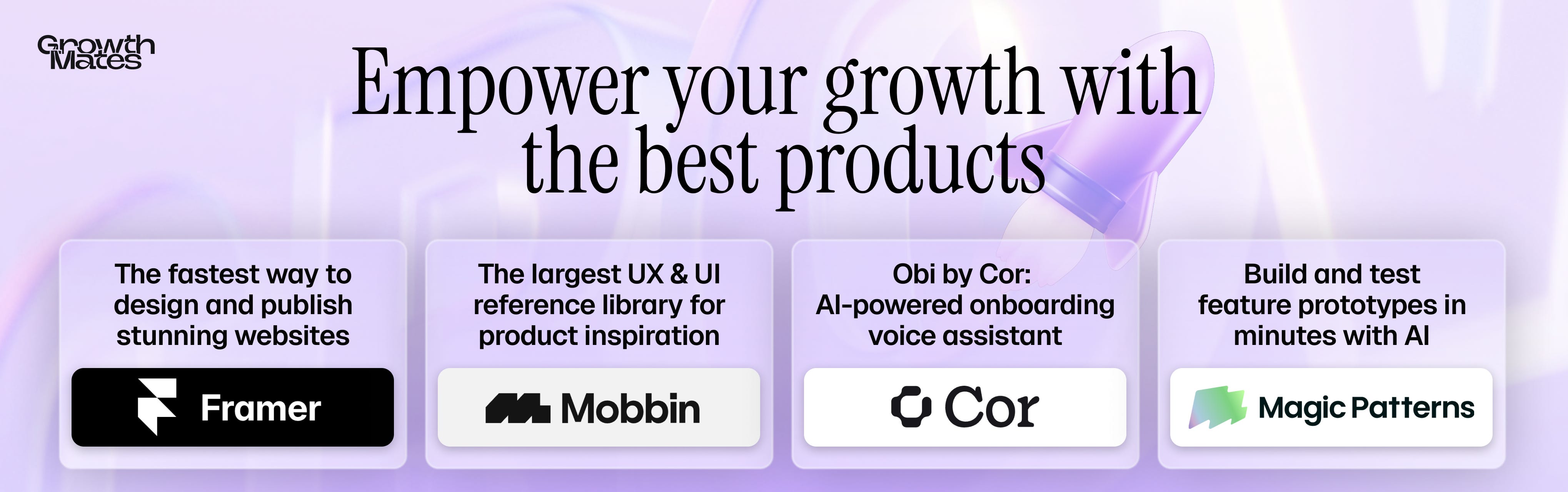
I curate the Growthmates Bundle to share not just ideas — but the tools I trust and use in my own work. Each one is a handpicked #1 tool for a key product area, and I’m proud to have them supporting this newsletter 🖤
Best way to support Growthmates? Explore these fantastic tools below 👇
Framer — the fastest way to design and publish stunning websites (Growthmates.club is built on it).
Mobbin — the largest UX & UI reference library for deep product inspiration.
Obi by Cor — AI-powered onboarding voice assistant, I truly recommend.
Magic Patterns — The fastest way to prototype and test new features with AI.
What you’ll learn today:
So today, I’m sharing 3 AI tools that genuinely surprised my growth teams — not in theory, but in real workflows:
Testing ideas with real data before shipping;
Prototyping critical flows in minutes, not quarters;
Turning onboarding into human-like guidance;
Building working apps without waiting for engineering.
Now, let’s dive into today’s story 👇
1. Figma Make — test ideas within a real context and data.
A year ago, I couldn’t imagine testing a prototype with real data. Today, Figma Make quietly changed that assumption.
👉 What it does:
Figma Make turns prototypes from “looks nice” into “behaves right”. By integrating with tools like Supabase, you can build fully interactive, data-backed prototypes — without writing production code:
real content instead of placeholders;
working auth and forms;
live API calls;
persistent app state.
The community is already building things that used to require engineering: from research platforms and checkout flows to AI assistants and even full canvas apps.
🎯 How you use it for growth:
I see a lot of potential for Growth and Product teams to use Figma Make to:
validate activation flows before development;
test pricing logic, onboarding steps, or AI interactions;
run user tests on behavior — not just UI opinions, and more.
Instead of asking “Do you like this?”, you can finally ask: “Can users actually complete this?”
🛠️ What you can build with Figma Make:
I checked what Figma Community already built with it, and I was really surprised to see well-polished products, websites, and apps with some backend data.
Here’s a sneak peek of what I found 👇
What really changed my mind wasn’t the feature list — it was what people started building once prototypes stopped relying on fake data.
With Figma Make, teams are no longer testing ideas about products. They’re testing small, real versions of the product itself.
Here are a few examples that show where prototyping is heading:
A research report site with real backend data
Not lorem ipsum — real content, real structure.A trip planning prototype with live travel data
Actual itineraries flowing through the UI.A working AI assistant
This isn’t a fake chat screen — it processes inputs and responds like a real product.A full e-commerce checkout
Real cart logic and decisions, ready for drop-off testing.A dynamic pricing page
Numbers change based on user input — perfect for testing value perception early.A full canvas image editor
An entire functional editor — inside a prototype.
🚀 One specific win:
You can now validate whether something behaves right — before a single line of production code is written.
📌 Takeaway: Being data-informed is no longer a post-launch luxury. It just became possible at the prototype stage.
2. Magic Patterns — build growth prototypes in 10 minutes.
Sign-up is one of the most expensive assumptions in B2B SaaS. And yet, most teams promise to “fix it next quarter”. Magic Patterns makes that excuse disappear.
👉 What it does:
Magic Patterns is an AI-powered prototyping tool that helps you design and iterate on real growth flows — fast.
Using agent mode, you can generate complete multi-step experiences:
sign-up and profiling flows;
onboarding paths;
role-based variations.
All grounded in real-world SaaS patterns (not generic wireframes).
🎯 How you use it for growth:
I used Magic Patterns to prototype a 6-step B2B sign-up flow in under 10 minutes:
role-based questions
progressive profiling
activation-aware paths
If you want to see the process end-to-end, here’s a 14-minute demo walking through the exact flow:
Teams use it to:
test qualification logic early;
align onboarding with real user intent;
run user tests before Q1 planning or roadmap commitments.
👉 Want the full breakdown? I documented the entire process — prompts, structure, and testing approach — step by step here:
🚀 One specific win:
You can test your most critical growth assumption — who your users really are — before they ever hit the product.
📌 Takeaway: Most activation problems start before the product. Magic Patterns lets you fix them at the source.
3. Obi by Cor — turn your onboarding into AI-assisted calls.
I’ve studied 100+ onboarding flows over the last 7 years. And one thing is clear: we don’t need more checklists. We need more human guides.
👉 What it does:
Obi by Cor is an AI voice (and video) assistant that lives inside your product.
Instead of clicking through steps, users can:
talk to the product;
explain what they’re trying to do;
get real-time, contextual guidance.
With Obi 2.0, this goes even further — into AI-assisted onboarding calls that feel like live training sessions.
🎯 How you use it for growth:
Teams use Obi to:
replicate human-led onboarding at scale;
guide users through complex setups and integrations;
observe where users hesitate via call recordings.
It’s especially powerful for:
context-heavy products (finance, HR, compliance, healthcare);
AI-native tools;
multi-user or enterprise onboarding.
🚀 One specific win:
Real friction doesn’t happen when users are watching. It happens when they’re trying — and that’s exactly where Obi shows up.
📌 Takeaway: Onboarding stops being “what to click” — and becomes help at the moment of action.
🎯 Where all of this is pointing
These tools don’t replace growth teams. They remove the friction that slows good teams down.
Across all three, I noticed the same pattern:
Prototypes are becoming behavioral, not visual (Figma Make).
Critical growth flows are being tested before roadmaps are locked (Magic Patterns).
Onboarding is shifting from steps to human-like guidance at the moment of action (Obi).
Different tools. Same shift.
👉 AI works best when it shows up exactly where humans get stuck. And that’s the bar I now use to decide what actually sticks.
What I’m watching for 2026 🚀
These three tools are just the start.
Together with Kyle Poyar, we’re preparing a comprehensive AI Growth Stack for 2026 — mapping where AI actually creates leverage across acquisition, activation, onboarding, and expansion.
We’re dropping the full stack in February, so stay tuned.
👉 If there’s an AI tool you’re curious about — or one you think is overhyped — reply to this newsletter and tell me what you want me to cover next.
I’m especially interested in tools that:
changed how your team works;
replaced a manual growth workflow;
or surprised you after the hype wore off.
🤝 Would like to work together on PLG in 2026?
As 2025 wraps up, I’ve been reflecting a lot on the kind of work that actually creates impact.
Over the last few years, I’ve intentionally moved toward deeper, more focused collaborations — the kind where there’s time to think, challenge assumptions, and build something meaningful with a team, not just for them.
That’s the energy I’m taking into 2026. Because of this, I’m keeping my client work deliberately small and focused. Q1 will be the only window for 1:1 work for a while.
If you’ve been thinking about strengthening your onboarding, activation, or PLG foundation — this is likely the right moment. Here’s what I’m opening up for Q1:
Onboarding Design Sprint 🏃♀️
I will work closely with your team to help you fix your product growth challenges and improve the first user experience that can drive x2 uplift on your Activation.
👉 Work with me → (only 1 slot for Q1 🔥)
PLG Advising for your team 🧠
Hands-on, in-depth advising across product, UX, and growth to build a scalable, sustainable PLG system that will last for years.
👉 Work with me → (only 1 slot for Q1🔥)
PLG Training for your team 🎓
A structured PLG training using the same frameworks I’ve taught teams at Grammarly, Autodesk, Monday.com, Intercom, Atlassian, and more.
👉 Work with me → (2 slots for Q1🔥)
Brand Partnerships 📩
Let’s tell your product story to a trusted audience of 30,000+ product, design, and growth leaders — and co-create meaningful content that inspires the wider product and design community.
👉 Send an inquiry to hello@growthmates.club (2 slots for Q1 🔥)
User-centric Growth Course 🎓
If these frameworks sparked new ideas — imagine working through your actual product challenge with my feedback, templates, and a dedicated community (AI will be there as well). This week, you can save 150$ for the enhanced program.
👉 Join with 150$ off → (starts already next week 🚀)
Premium Edition 💎
If you’re getting value from this newsletter, get access to full archive with more frameworks, teardowns, and exclusive content on PLG, Activation, AI, and how to build meaningful products that delight users.
👉 Upgrade to Premium and get full access.
This is all for today, dear readers. If you found this helpful — please share your reaction and leave some comments 💜 It would give a huge support for me to continue creating this!
If you find this newsletter valuable, share it with a friend, and consider subscribing if you haven’t already. There are some discounts available, and maybe you can expense this :)
Connect with me on LinkedIn and learn more about my work on Growthmates.club.
With best regards,
Kate Syuma


