15 bitter truths about Growth: how to scale without sacrificing quality
A short, practical list of what truly drives sustainable product growth — without breaking experience.
Hello everyone 👋 I’m Kate Syuma, and welcome to Growthmates.news — the newsletter where we explore growth stories to inspire your professional and personal growth. Join the community of 7,300+ Product, Design, and Growth people from companies like Amplitude, Intercom, Miro, Atlassian, Grammarly, Framer, and more.
After leading Growth Product & Design at Miro, I’ve seen how easy it is for teams to over-optimise for metrics and under-invest in experience. And in the last months, after speaking with 200+ people at Autodesk and training 60+ growth practitioners at Monday.com, one thing became clear:
PLG doesn’t work without UX — and UX doesn’t scale without PLG thinking.
This merge (PLG + UX) has been at the core of my work for years. It’s also what I started translating through my early posts, including:
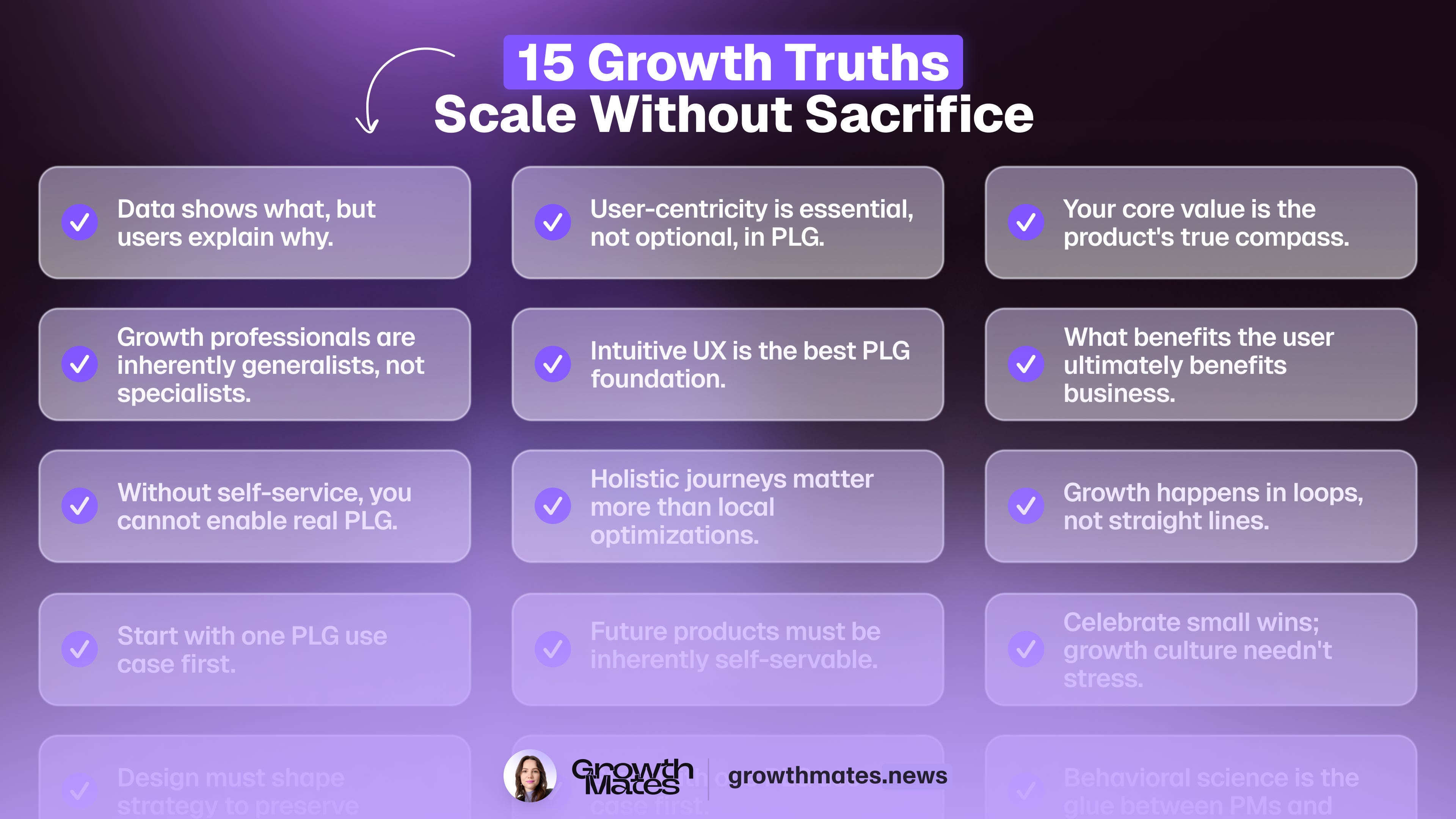
Today, I want to share 15 bitter truths about growth — the ones that help you move fast, innovate boldly, and still keep product quality high.
Before we dive in… Meet Growthmates Partners 🚀
I curate the Growthmates Bundle to share not just ideas — but the tools I trust and use in my own work. Each one is a handpicked #1 tool for a key product area, and I’m proud to have them supporting this newsletter 🖤
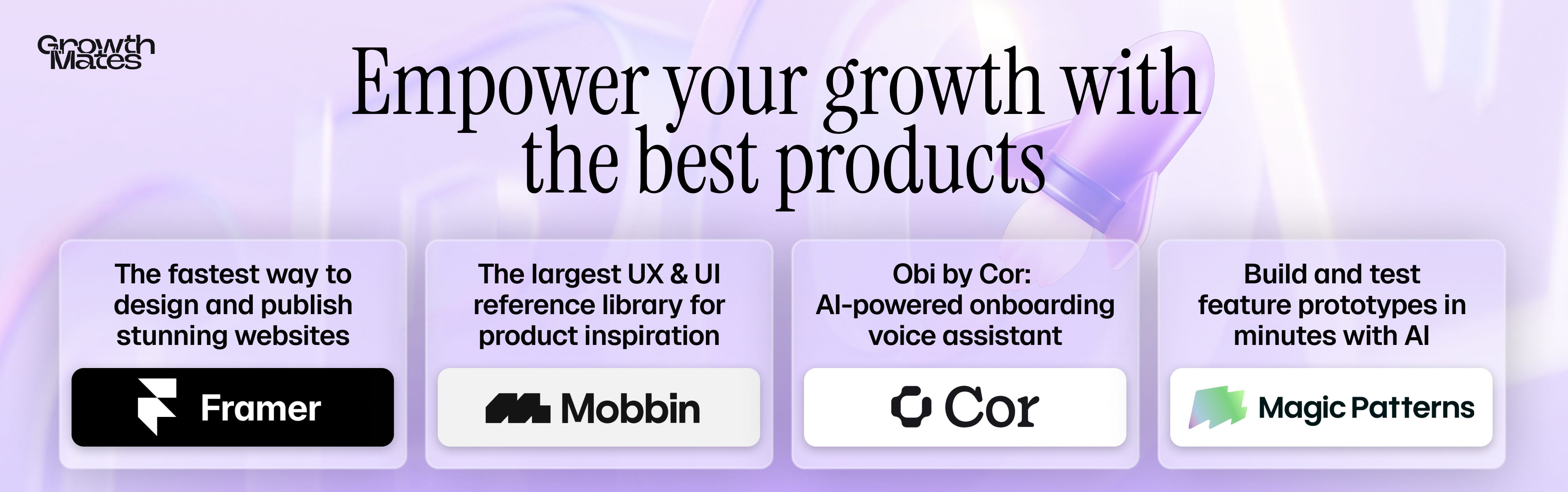
Best way to support Growthmates? Explore these fantastic tools below 👇
Framer — the fastest way to design and publish stunning websites (Growthmates.club is built on it).
Mobbin — the largest UX & UI reference library for deep product inspiration.
Obi by Cor — AI-powered onboarding voice assistant, I truly recommend.
🆕 Magic Patterns — The fastest way to prototype and test new features with AI.
What you’ll learn today:
Why PLG only works when UX is baked in from day one.
How focusing on core value, loops, and holistic flows accelerates sustainable growth.
The key principles that help teams move fast, experiment boldly, and still protect product quality.
Now, let’s dive into today’s story 👇
15 bitter truths about growth.
Over the years, I’ve distilled hundreds of experiments, talks, and hands-on product work into 15 core truths. Here’s what actually moves the needle when growth and quality go hand in hand.
1️⃣ Data tells you WHAT, users tell you WHY.
Your dashboards highlight where the problem is, but they never reveal the underlying cause. Without qualitative checks, teams keep fixing symptoms, not mechanisms. Add short validation loops (5–7 moderated or unmoderated tests) after each major experiment — your insights will instantly become more actionable.
The only way to check the why is to do some user validation.
2️⃣ User-centricity isn’t optional in PLG, it’s the core.
PLG collapses if the product doesn’t deliver the user’s desired outcome quickly and clearly. The best growth loops start not from acquisition tactics, but from a deep understanding of the outcome the user came for.
What is good for user is also good for business.
3️⃣ Your core value is your product’s compass.
What motivates users to choose your product over all others? → Core value.
Core value is the anchor for creating user-centric experiences that drive sustainable growth. To define it, answer:
What critical problem does the product solve?
What actions must the user take to experience that value?
What tangible benefit do they get?
Here is a simple core value formula:
Our product helps [USER] solve the [PROBLEM] by taking [ACTION], so they can achieve [DESIRED OUTCOME].
Most teams define core value once and never return to it — but it should be a recurring practice. Revisit it monthly as your product (and user needs) evolve.
Ready to put this into practice? Turning this core value into a growth engine is both an art and a science. We explore the exact frameworks for this in the User-centric PLG in AI Era course (150$ off for dear readers) — your next step to building a magnet product.
4️⃣ Growth people are generalists at heart (so am I).
High-performing growth teams aren’t siloed — they’re hybrid. PMs who understand design, designers who understand metrics, analysts who understand UX. That overlap reduces dependencies and makes experimentation x10 faster. This cross-functional literacy makes collaboration smoother and reduces “handoff friction”.
Growth people become more and more generalists.
The full story about this truth is in my article 👇
5️⃣ Hyper-intuitive UX is the best foundation for PLG.
When users instantly understand how to progress, every downstream metric becomes easier to improve: activation, habit creation, retention, monetisation. No amount of nudges will fix a confusing interaction.
All the best products we know… are extremely intuitive and great from the user experience perspective.
The full story about this truth is in my article 👇
6️⃣ What’s good for the user is good for the business.
This principle solves 80% of prioritisation conflicts. If you help users achieve the outcome faster and more confidently, revenue follows. The hard part is defending this principle during high-pressure cycles.
Just remember that and remind about yourself about this every day and you will be good.
P.S. Want every article on time?
Subscribe to my Substack, if you haven’t yet 💜 As a subscriber, you’ll get each new article delivered promptly, ensuring you never miss a breakdown or insight.
7️⃣ If your product isn’t self-servable, you can’t enable PLG.
Self-serve isn’t a feature — it’s a philosophy. Users should be able to explore, activate, and pay without a human in the loop. This requires clarity, predictability, and frictionless navigation.
Self-serve is not about removing humans — it’s about removing dependency on humans.
The idea of self-servable experience is that user can do anything inside the product without any human intervention.
8️⃣ Holistic experience matters more than local optimisations.
Teams love celebrating small A/B wins — but isolated improvements rarely compound if the overall journey is broken. Think in journeys, not screens. Fix the connective tissue.
In growth, we should think in flows, not in features.
The full story about this truth is in my article 👇
9️⃣ Growth happens in loops, not lines.
Linear funnels (A → B → C → revenue) oversimplify reality. Growth accelerates when users cycle through loops: core value → habit → expansion → advocacy. If a loop is weak, no landing page fix will save you.
Growth happens and looks not in lines.
🔟 In scale-ups, start with one use case for PLG, enable it, then scale.
Trying to “PLG the entire product” at once usually leads to chaos. Instead: choose one flow, make it fully self-servable, measure, refine, and replicate. Focus is a growth accelerant.
Start small… figure out the proper candidate… start enabling these.
1️⃣1️⃣ By 2026, more product experiences should be self-servable.
The future belongs to intuitive, community-powered, low-touch products. Teams must design for clarity and autonomy from day one — not as a retrofitted “growth initiative.”
Some recent tools, like Lovable, already show how complex products can be self-servable from day one, while still delivering a delightful experience.
My hope… by 2026 we will see more PLG, self-servable products plus community-driven growth enabled from day one.
1️⃣2️⃣ Growth culture shouldn’t be stressful. Celebrate small wins often.
Experiments fail often. The culture you build around failure determines the speed at which your team learns. Ritualise learning: quizzes, celebration moments, transparent dashboards — and experimentation becomes energising.
Turning this stress into curiosity… is a very good decision.
To help you build these rituals, we’ve compiled practical tools in our free Growth Playbook. Download it and start implementing 👇
1️⃣3️⃣ Growth design should influence product strategy, otherwise quality is compromised.
When design is brought in too late, shortcuts appear, usability suffers, and long-term growth slows down. Design is a strategic partner — especially in PLG.
If we work in silos… I have never seen this culture working well long term.
1️⃣4️⃣ Designers should see the impact of their work in numbers and be able to articulate it.
Great design is not just delightful — it’s measurable. When designers present work together with user outcomes and metric shifts, their influence inside the organisation increases dramatically.
This isn’t about making design “quantitative” — it’s about showing how design decisions shape real user outcomes.
They cannot present the metric outcome impact result.
example portfolio: Elvis Obanya - TBD
1️⃣5️⃣ Behavioural science is the “glue” between PMs and Designers, it explains the why behind UX.
Define the problem. Write the hypothesis. But also ask: “What is the user feeling here?” Friction, anxiety, hesitation — remove them early. It accelerates experiments without sacrificing quality. Behavioural science helps PMs and designers speak the same language — the language of human motivation.
What is the user feeling here? Friction, anxiety, confusion — remove them early.
The full story about this truth is in my article 👇
P.S. This topic is a cornerstone of the practical framework I teach in my course.
⭐️ The essence of all 15 truths:
If I compress everything we explored today into a single idea, it’s this: Sustainable growth happens when user outcome, product quality, and experimentation speed reinforce each other — not compete.
At the heart of all of them is a simple principle:
What’s good for the user is good for the business — and what’s clear for the user is scalable for the team.
Growth isn’t magic. It’s a craft. A discipline. A way of building where UX and PLG don’t live in separate rooms, but instead shape each other every day.
🤝 More ways I can be useful to you:
Onboarding Design Sprint 🏃♀️ or PLG Advising.
I will work closely with your team to help you fix your product growth challenges and improve the first user experience that can drive x2 uplift on your Activation.
👉 Work with me → (only 1 slot for Q1 🚀)
User-centric Growth Course — 5/10 discounted spots left for January ❄️.
If these frameworks sparked new ideas — imagine working through your actual product challenge with my feedback, templates, and a dedicated community (AI will be there as well). This week, you can save 150$ for the enhanced program.
👉 Join with 150$ off → (promo “growthmates” for dear readers)
Brand Partnerships 📩
Let’s tell your product story to a trusted audience of 29,000+ product, design, and growth leaders — and co-create meaningful content that inspires the wider product and design community.
👉 Request content partnership: hello@growthmates.club
Premium Edition 💎
If you’re getting value from this newsletter, get access to full archive with more frameworks, teardowns, and exclusive content on PLG, Activation, AI, and how to build meaningful products that delight users.
👉 Upgrade to Premium and get full access.
This is all for today, dear readers. If you found this helpful — please share your reaction and leave some comments 💜 It would give a huge support for me to continue creating this!
If you find this newsletter valuable, share it with a friend, and consider subscribing if you haven’t already. There are some discounts available, and maybe you can expense this :)
Connect with me on LinkedIn and learn more about my work on Growthmates.club.
With best regards,
Kate Syuma


